Showing posts with label Downton Abbey. Show all posts

Monday, 24 December 2012

The Christmas 2012 Schedules


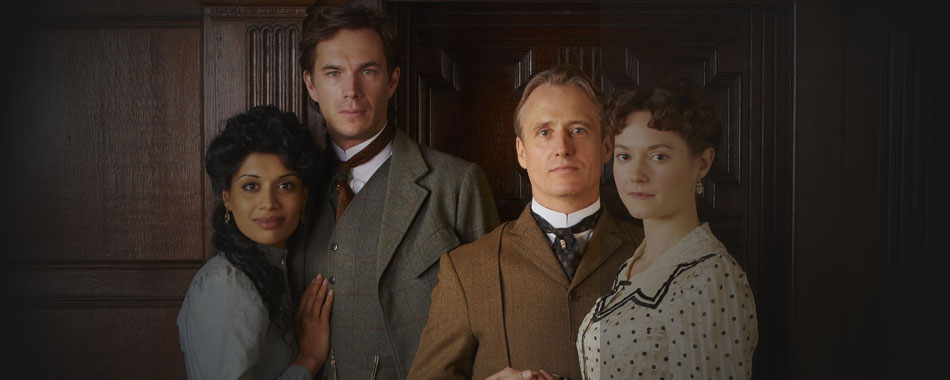
Not strictly Christmas, but near enough, and in content as Christmas as it gets: The Making of a Lady.  Frances Hodgson Burnett wrote the strange novella 'The Making of a Marchioness' followed by 'The Methods of Lady Walderhurst' which, several years behind 'The Secret Garden' have finally made it to the screen.  On the page, they read as an uneasy mix of light social commentary and high melodrama.  Television does us proud, therefore, by ditching the former and playing the latter with the straightest of faces.  Poor-but-respectable Emily Fox Seton (Lydia Wilson) marries unpromising-but-rich Lord Walderhurst (Linus Roache) and after the briefest of good starts - sex is ok and he's teaching her to swim, by Gad - he takes off to India for the Honour of the Regiment and leaves her at the mercy of his scheming cousin Alec Osborn (James D'Arcy) and Alec's wife Hester (Hasina Haque).  With the help of Hester's elderly ayah, Ameera, they plan to poison Lady W before she gives birth to an heir, thereby inheriting the house.  As stuffed with TWNH moments as your average turkey is with chestnuts, but fabulously daft fun.


Last night we were Loving Miss Hatto.  Penniless chancer William Barrington Coupe (Rory Kinnear) meets promising pianist Joyce Hatto (Maimie McCoy) in 1953 and is smitten with both her and her potential.  They try to overcome the disadvantages of a lack of contacts, her stage nerves and her vicious mother, but after some success they go no further and settle for a life of suburban quiet, natural history programmes and buns for tea.  When older William (Alfred Molina) manages to fake a CD of one of Joyce's recitals well enough to fool her and fans on an internet forum, he takes it up in earnest, to bring her the acclaim she deserves, and soon Joyce (Francesca Annis) is being sought by the likes of Radio 3 and Gramophone.  All of this, of-course, brings the fraud closer to the surface.  As with 'Housewife 49', Wood writes with candour, humour and ease about 'ordinary' Englishmen and women battling life's odds.  Drama for audiences with Dysons, written about people who could never have them.  Dare we say thank heavens for the much-maligned BBC?


Tomorrow there's a good helping of 'Call the Midwife' followed by lashings of 'Downton Abbey'. The only spoiler alert necessary is that of their combined effect on a digestion loaded with Christmas dinner and pudding  is likely to be messy.

P.S. It was messy.  The Workhouse Howl of one morphed into a wail for the insufferably good Matthew in the other.  Heaven forbid there should be real surprises on Christmas Day, so news of Dan Stevens wanting to exit was publicised some while ago....


The Girl.  Hadn't got around to watching this on Boxing Day.  Cups overfloweth etc.  We were busy watching the below.  So, a few days late, we watched the drama chronicling the making of 'The Birds'.  Toby Jones is a wonderfully slimy, sinister Hitchcock while Sienna Miller is rather less mannered and vacuous than Tippi Hedren always appeared in both 'The Birds' and 'Marnie'.  The material is discomforting, both because of its nature and because of the fact that it's been the subject of intense conjecture for decades, so while this offers nothing new in the way of knowledge, it offers a very definite take on the events during filming - Miss Hedren's.  Maybe it's as near to the truth as dammit, and maybe we shouldn't care, so long as it offers 90 minutes of entertainment, but... we suspect a full-blown biopic of Hitch could fill almost as many hours as his life, and the real and the lurid imaginary would be almost indistinguishable.  Maybe the best and only insight into the strange talent that was Alfred Hitchcock is his string of films.


Doors Open, which almost justifies the term 'crime caper'.  Ian Rankin, Stephen Fry, Douglas Henshall, Leonora Critchlow and that painting of a woman that turns up on Penguin Classics, not necessarily in that order, can together offer perfect Boxing Day fare.  There's love, there's theft, disillusion, art treasures, heartless bankers, a spot of double-crossing and an absolutely mad plot.  Sit back, relax, enjoy, and don't do this at home.


Restless - Half of us have read the novel this was based on, by William Boyd, and that half was pre-disposed to like this adaptation.  The other half felt it was a tad cliched.

British agent turns out to be a double agent working for the Russians, who sets up his colleague and lover to further the ends of his Soviet masters.  She evades death, and him, for some thirty years but is always conscious of being on the run.  It was a fun watch (says the non-book half) with the likes of Hayley Atwell, Rufus Sewell, Michael Gambon and Charlotte Rampling all acting their woolly socks off, but sometimes it was woolly elsewhere too.  No doubt all these points are explained in the book, but here it wasn't clear: Why did Romer (Sewell, later Gambon) choose to set up Eva (Atwell, later Rampling) assuming she would be anti-Russian despite... being Russian?  How did his assumption that she wouldn't follow orders and would discover the terrible forged Nazi maps help him?  Why did she send her daughter Ruth (Michelle Dockery, swapping flapper for hippy) to meet Romer when she could surely have found the information without revealing her true identity and thus putting herself in danger again?  What did she have on Romer to make him kill himself?  And while the Russian phone books, not to mention coffee table books on Matisse, may be full of Delectorskayas, it sounds like a highly unsubtle way to promote her delectability as the heroine.

Still heaps better than 'Charlotte Gray' though, if nothing else for the message that espionage will leave you permanently paranoid.


Panto - obviously we were too busy watching 'Restless' to have seen this when originally aired.  Coming to it on 4th January, we conclude it was best watched in a festive haze.  It shouldn't have been a stretch for John Bishop to act the part of a feckless and fun-loving DJ but he suffered from the same affliction that Jerry Seinfeld did when acting his own comedy script: smirking when he should have been showing any other emotion.  Harmless fun but no surprises beyond perennial villain Michael Cochrane playing an "accc-TOR" reduced to being a (wonderful) pantomime dame.


Ripper Street, so-named in case you forget that this is 1889, dramatizes a range of stories which are, of necessity, not nearly as interesting as that of Jack the Ripper.  To be fair, it'd be hard to film anything set in 1889 with a modicum of atmosphere without resorting to cliche.  So we're in the grimy (though mercifully not foggy) London streets with strutting prostitutes and an early entrepreneur leading Whitechapel Walks.  Nearby, men in severe need of a bath are foaming at the mouth at a bout of bare-knuckle fighting involving Jerome Flynn.  (He comes by way of the RSC and Soldier Soldier, dear viewers).  Altogether it's sold almost as a Western, with the beleaguered cops battling shady types in a lawless town. 

The discovery of a victim with the hallmarks of the Ripper involves Detective Matthew McFadyen and his ex-boss, Fred Abberline, who has been dragged in from reality as the lead investigator of the Ripper crimes in 1888.  Our hero McFadyen suspects this is not the Ripper but has been made to look like it.  Think 'Whitechapel' with corsets and say 'copycat'.  Say also 'modern sexual sadism projected onto a historical past'.  No doubt akin to 'City of Vice' and 'Garrow's Law' this will feature other modern preoccupations in its run.  There is a posh baddie with an ugly moustache, and prostitutes treated as expendable actors in pornographic violence.  MyAnna Buring rounds off a busy year as a Madam, while Amanda Hale who played the mad wife in 'The Crimson Petal and the White' remains trapped in bustles as the detective's wife.

It's alright, in a 9pm Sunday sort of a way, but was probably more fun to make than it is to watch.

Dan adds:  For me, this was a 1970s cop show in fancy dress.  The plot was very 1970s (porn, snuff movies), and the cops beat up suspects and charged around doing what they wanted; as with Life On Mars the BBC managed to make a 1970s cop show in disguise, this time taking it 90 years earlier.  I'm not complaining, but why can't they just do one in modern dress for a change?

Ali adds:  C'mon Dan, they do endless cop shows in modern dress!  Don't forget it's harder to mix in real people in modern shows.  Mob leader Lusk turns up in episode 2.  We're holding out for Queen Victoria....


Remember 'The Paradise' and thinking idly how it was probably based on a department store like Selfridges?  (More Galeries Lafayette, since it was Zola, but hey).  Well here it is, the supposedly real story of the Oxford Street favourite, and the best ad they could ever want.  Mr Selfridge has the love interests, the love of retail (yawn), the ambitious sales girl (Aisling Loftus, who has yet to put a foot wrong in her career), the leaden script and the handsome Frenchman from 'Spiral' (Gregory Fitoussi as artist Henri LeClair).  The only things it lacks are the yellow bags and the hordes of tourists.  It's so like 'The Paradise' though that even the archetypes are present: there's a Miss Audrey type (Amanda Abbington), a bitchy sales assistant jealous of our ambitious heroine etc.  Soon we'll be asking where the Miss Audrey is in any department store we visit.

The first 90-minute-minus-ad-breaks episode covered the building and opening, but like 'The Paradise' (TP) it's less of a rags-to-riches story than an already-fairly-rich soap opera.  Jeremy Piven as Harry Gordon Selfridge declaims every line as though to a theatre audience.  If true, this must have been very tiring for his long-suffering wife (here played by Frances O'Connor), even more so than his dalliance with a music hall artiste, Ellen Love (Zoe Tapper).  Sam West, Tim Woodward and a barmaid from Corrie turn up to befriend or use our Mr S, who proves his many hidebound critics wrong and opens a stunner of a store on the 'dead end of Oxford Street'.  These were, lest we forget, the days before Primark when, errr, Tyburn Gallows wasn't quite quoshed in public memory and shoppers presumably hadn't cottoned onto the existence of either Liberty's or Whiteley's.

It seems as we leave the turn of the century behind that we're increasingly turning back to the turn of the last one for comfort telly.  OK, so the direct competition in the schedules is Ripper Street, which isn't exactly comfortable viewing, but the choice is between the swishing fabrics and gilt elevators of the 1900s West End and the nasty, brutish and short lives of (in episode 2 at least) some nasty, brutish and short villains in the grimy, gaslit East End.  Children in 1889 may have been victims, forced to work like slaves or join a gang and murder people, but at least it was all a long, long time ago.  In the light of the Savile investigation, no-one who watched 'I Love the 1970s and 1980s' series can still think of light entertainment figures as eccentric but essentially benign men with terrible dress sense.  The 1870s and the 1880s are much safer viewing.

Tuesday, 3 January 2012

Festive Feasts 2011 - spoilers


Downton Abbey – The Christmas Cracker.  Sensibly, this developed earlier storylines, albeit tedious ones, and brought them to at least some sort of resolution.  The breathing space of a two-hour slot, minus many ad breaks, meant fewer of the twenty-second scenes and would have added a little credence to plotlines from series two such as the disfigured claimant.  It almost managed to avoid being tongue-in-cheek except for a few innuendos which must have got them sniggering at the read-throughs.  The biggest TWNH was the Crawleys turning out en masse for Bates’s murder trial, and at Christmas!  Dear dear me....

But, with 1920 already begun, i.e. eight years having passed since the first episode (onscreen, of-course, it hasn’t been that long in reality, however wearisome), how long can life stay essentially the same for everyone at the Abbey?  And with Jonathan Ross featuring a spoof Carson Christmas Album, surely series three should be the last?


Fast Freddie, the Widow & Me – We’ll be honest, this looked sentimental, clichéd and better suited to children’s tv, so out of respect for Lawrence Fox and Sarah Smart, we gave it a miss.

This is England 88 - This definitely took us back to '88 - it was very similar to 'Brookside'.  Lots of laughs from peripheral characters, and lots of bleak stuff in the main storylines, and like in Brookside she killed her dad (not a spoiler because that happened in '86). 


Lol is 'This Is England's version of 'Mad Men's Betty, in that she can be guaranteed to remove any fun from any scene, and also as Lol she's the most inappropriately named character in the history of TV drama.  


Nonetheless, Vicky McClure deserves every award going for her portrayal of a woman on the verge, and her scenes with Joseph Gilgun (Woody) at the end were very emotional in the best possible way.  It wasn't as good as '86 - Mick (Johnny Harris) was the scariest TV villain of recent years - but it wasn't as bad as '86 either: no daft weddings, shaggings or group sing-songs this time.  If they do '90 we'll watch, but please can it be a bit less bleak? 


Great Expectations – What better way to spend Christmas than among the mouldering remains of Satis House with mad Miss Havisham, cold Estella and social-climbing Pip?  As a story, it’s unfair to judge it on its merits, which are firmly of their time, but as an adaptation, and an umpteenth one, it started badly.  The first episode crept along slower than the dry rot in the house and the casting jarred.  Gillian Anderson obviously enjoys playing against her glamorous image these days, judging by this and her turn as Mrs Castaway in ‘The Crimson Petal and the White’, but here she looks like a twenty-year-old with a skin condition and an off-the-vintage-peg frock.  She probably is about the right age for Miss H, as opposed to the old grand dames who have played her in the past, but Miss H would look older than her years, not younger.  The casting seemed to operate in reverse for the Gargerys, who were cast older, but look about right in terms of the premature ageing that comes with a hard life.  Douglas Booth as Pip was also odd, since he seemed always to belong to a later era and to Eton rather than a rural Victorian forge.  Only Ray Winstone as Magwitch seemed recognisably Dickensian.

The second and third episodes picked up the pace and were subsequently a more enjoyable watch, but we can’t help but wonder whether money was well spent in yet another remake, rather than showing a previous version and spending the money on a less-adapted work or even, horreur, original drama?

Ben Hur – Tucked away on Channel 5, this required herculean effort on the part of the audience as well as the titular hero, at a running time of over three hours.  While Dan couldn’t get over the lack of Charlton Heston, whose appearance is required in anything sword and sandals, Ali quite liked it.  Like ‘Great Expectations’ it is, after all, an adaptation of a Victorian novel, and as such is bound to contain the same absurd coincidences and wholesome moral endings that characterised most similar fiction.  Get over that, and you had an entertaining tale of friendship, love, betrayal, revenge and forgiveness – the usual, in other words – with what seemed a reasonable production budget and a decent cast.  There was something about Hollywood epics that suited these overblown tales, that doesn’t quite translate to the earthier, bloodier and more sexually explicit approach of modern takes on the era such as ‘Rome’.  Combining an old story with a new adaptation is a risk that seemed to pay off here though, maybe because most of us know too little of the ancient world to spot the anachronisms, but with the likes of Marc Warren, Art Malik, Alex Kingston and Ben Cross appearing, not to mention Magwitch and the Earl of Grantham turning up as a decent Roman and Pontius Pilate, respectively, you know you’re in good hands.

Sherlock - pacy, witty, fun and, were we adolescent, probably one of the best things on TV.  As it is, well ok, it's still one of the best things on TV, providing perfect Sunday evening viewing, with a nod to Conan Doyle and a wink to the audience.  Bring on the Hounds!

And bringing up the rear...

Endeavour – The words 'barrel', 'bottom' and 'scraped' came to mind on hearing about this.  What next?  Young Marple?  Even older Poirot?  Not a new idea either, given the juvenile Bonds, Sherlocks, Indiana Joneses and James Herriots ('Young James Herriot'?  We just couldn't.)  that have populated the shelves and/or screen for a while.  It wasn't as bad as it sounded.  Shaun Evans had clearly studied the late John Thaw's mannerisms and cadences of speech, and Roger Allam added some nicely underplayed support as his boss, Inspector Thursday.  Otherwise, it has to be said, this felt like overkill.  It added nothing to the genre in either style or substance, the story being one that could have featured in 'Gently' or even any modern procedural, like... 'Lewis'.


What distinguished early 'Morse' was subtlety and class: a superior script, quiet performances and a mood of death and secrets conjured by Barrington Pheloung's haunting score and slow-panning camerawork that was almost languid.  What bound the spell was the central performances of Kevin Whately and John Thaw as Lewis and Morse, characters well enough developed from their literary origins, but blessedly free of the cliched quirks and ticks and private-life complications that so easily distract.  The quality had declined somewhat, a while before Morse's fatal collapse in a quad in his beloved Oxford.


Then came 'Lewis', a pale shadow of its predecessor with so-so scripts and unlikely plots.  And now, 'Endeavour'.  Pointless discussing it as a stand-alone drama, since every five minutes there's a huge hurrah for Morse and even Thaw fans.  His daughter Abigail Thaw's cameo had her asking the young DC Morse whether they'd ever met and responding to his negative reply with, "Maybe in another life".  A wholly inconsequential moment, plotwise, and a crossover from internal logic to fan followings.  Not content with merely showing young-pup Morse, we are also offered the origins of his love of opera, beer and jaguar cars.  Are we missing anything?  Oh yes, the opera heroine and potential love interest turns out to be whodunnit.


The hum-drum is not the worst of it either, there's at least one juicy TWNH.  A shady, sinister government type produces a very large gun at the end and threatens a politician with a bullet if he doesn't resign.  Somehow we think if this were an approved tactic, that given the number of resignations by arrogant politicians, there would doubtless be a decent handful of assassinated ministers over the last forty years.  Step forward any pro-Morse conspiracy theorists?

Sunday, 13 November 2011

Downton - spoilers!

From the frantic searches based on the above title, we assume fans of the ‘Abbey’ are desperate for news.  Our lips are sealed on series 3 and the Christmas special (though we know that Santa himself has been in negotiations for a cameo appearance), but we can reveal, from a source known only as ‘Creepy Crawley’ that there are plans afoot as far ahead as series 5.  We are given to believe that:
·         HAVING found an heir, the Earl is so shaken by repeated threats to the inheritance that he hangs on and on, only dying on 3rd September 1939 at the thought of wearing a uniform around the house through yet another war.
·         MATTHEW, racked with guilt over Lavinia’s death of a broken heart, has got engaged to a series of lookalikes, only to lose all of them one after another when they realise that he is still in thrall to Lady Mary’s arched eyebrows.
·         SYBIL has joined the IRA in exasperation after her husband accepts the peace.  Unfortunately her wearing of dark trouser suits means she is arrested not as a terrorist, but being mistaken for her sister Lady Edith, who has joined Moseley’s new party.
·        LADY MARY has had a daughter with Richard Carlisle, who now runs the BBC as well as the Times.  She wants a son, but he dotes on the girl until he realises that she has washerwoman’s elbows that nothing can cure.
·         CORA has tracked down Jane and persuaded her to come and live at Downton as the Earl’s mistress, so that she can concentrate on good works with Isobel and the odd game of ping-pong with O’Brien.
·         WILLIAM’s ghost has been spotted whenever ‘11’ appears in the date.  Carson is slow to believe it until he himself finds the footman’s livery in his old room.  He’s rarely there since beginning a torrid affair with a fellow-servant (we can’t say!).  Downton hasn’t had a footman since 1920, when nasty O’Brien married Lady Mary’s parlourmaid in order to be near to Richard’s young and handsome brother.
·         SAVED at the eleventh (when else?) hour from the gallows, Bates is reprieved by a shady government enterprise on the understanding that he will spy on and, if necessary, assassinate subversive factions.  He marries Anna as cover but his work soon brings him into conflict with both Sybil and Lady Edith.
·         VIOLET expired after eating one of Mrs Patmore’s puddings, to which she added arsenic, misreading the label for arrowroot while wearing pink steamed-up spectacles.  She lives in fear of being discovered and is being blackmailed by O’Brien. 
More news from our inside ears as we get it.

Tuesday, 8 November 2011

Downton Abbey *spoilers*

"Don't think for one moment that you will see ME in dropped-waist frocks!"

Awards, ratings, a Christmas special and a third series.  Hmm.  ‘The Wire’?  ‘Mad Men’?  ‘The Killing’?  We’re wondering what series 3 of ‘Downton Abbey’ could possibly deliver.  Are there any clichés left?  That flicking sound is Mr Fellowes and co leafing through the pages of ‘The 1920s, a short introduction’.  We just can’t wait for the Charleston – not to mention the Black Bottom – mentions of gangsters and prohibition in New Yoik, the General Strike, jazz, flappers, aeroplanes and the rise of some brown-shirted types in decadent Berlin.  Meanwhile the staff are dwindling because they’re all off to the shops and the factories.  If we’re missing any stereotypical landmarks of the age, they’re sure to turn up next Autumn.

Monday, 31 October 2011

Downton Abbey, episode seven, series two


Watching 'Downton' is like viewing in fast-forward.  If the Keystone Cops turn up it wouldn't come as a surprise.  (The evenings are long now and the competition in the wake of 'Spooks' non-existent, so that's the excuse.)

Matthew walked!  Sybil eloped!  And came back!  Robert tried it on with a housemaid!  The O'Briens were ruined!  Bates is going to cop it for murder!  Richard tried to bribe Anna to spy on Mary!  Ethel burst in on an upstairs luncheon with her illegitimate baby!  Whom, btw, the short-sighted cook had recognised in an instant....  And everyone kept broadcasting that times, they were a-changing (life's so dull after a war, skirts and hair are getting shorter, there's this dreadful flu going around etc.)  It's all about as subtle as a poke in the eye, and as believable as if the poking finger belonged to Mickey Mouse.  Roll on WWII?

In the meantime, roll on 'Top Boy', which seems to have advance praise.  Same writer as 'Hidden' but we won't hold that against it.

Wednesday, 26 October 2011

Brass! (Downton Abbey spoiler alert)


Forget alchemy, forget fool’s gold, ‘Downton’ is now Brass.  That is to say, a surreal and funny parody.  Bradley Hardacre’s trouble at mill was billed as comedy, however, and in ‘Downton’ viewers have to look very hard, probably with HD, 3-D and freeze-frame, to find any sign of an actor’s tongue residing in their cheek.  Or for any intentional humour at all.  Well, there was a Great War on, don’t you know.  It was a time of such deprivation that the rich Crawley ladies were having to turn out week after week in the same dinner frocks.  I say!  Nothing to do with ITV budgets in our own straightened times then?

Last Sunday’s episode tipped the balance.  The previous two weeks had strained the scales with Lady Mary’s reedy-voiced rendition of ‘If I were the only girl in the world’, something she always seems to have believed, and a cameo by Harry Hill.  (No?  Different show?) and the deathbed wedding of footman William.  He looked remarkably well for someone who was dying, but clearly wasn’t up to the mark, since he failed to notice his bride’s utter lack of passion for him. This Sunday we had the brief re-appearance of the soon-to-be-ex Mrs Bates, before she exited in another way entirely.  Her snarling all-round villainy had us expecting a green complexion, a long warty nose and an even longer pointy hat.

We also had an English Patient-esque, errrm, Canadian patient, who claimed he was English.  He also claimed, through his burns and bandages, to be the heir to Downton, supposed drowned on the Titanic in the very first episode.  No DNA testing, no identifying features and only hazy memories of hiding from the nanny cut no ice, nor mustard, with the Earl, who preferred paralysed, barren Matthew to inherit rather than a “not very pretty” Canadian.  The discovery of a fellow passenger on the ill-fated liner with the same name as the wannabe heir sealed his fate, and off he wheeled into the sunset with a note to Edith about it being too hard to try to be a Crawley.  The silly girl had believed him.  She’d obviously never heard of the Titchborne Claimant.  Her dad’s granite countenance softened rather too much on seeing the new maid, taking us further into Hardacre territory.  All he needed was a fat cigar.  He’d been given a handy excuse, though, in the form of his wife’s sudden transformation into a schemer.  She'd reintroduced the wet Miss Swire to distract moping Matthew, thereby clearing the way for press baron Rupert Murdoch Richard Carlisle to intimidate Lady Mary into marriage.

Phew!  As if that weren’t enough for one episode, former maid Ethel was forced to give up hope of support from her caddish lover and father of her illegitimate child when he died at the Front, Lady Sybil is still half-heartedly pursuing the chauffeur, the sour-faced O’Brien duo managed to sneak in yet more smoking breaks and eavesdropping moments, while butler Carson was persuaded to forsake Downton for Lady Mary’s sake and... Matthew felt a tingling in his legs!  He’ll be up and about again in no time, we’re sure, and doing the Charleston in a mad attempt to forget the horrors of the trenches, until the Earl loses all his money in the Crash....

Ali will step away from 'Downton' and let Dan talk about 'Death in Paradise'.  Neither of us could face 'The Slap' but there's a reasonable UK press review of it here and another here.

Monday, 3 October 2011

Sunday nights, 9pm, ITV1


Not in costume.  Repeat: NOT in costume


The aforementioned alchemy is swiftly being exposed as fool’s gold this series (except for ITV, who are cashing in to the extent of dishing up 53 minutes of drama in a 75 minute slot).  Credibility is stretched to groaning point to service the soapy plots:
  • Despite being as large and grand a house as, say, Highclere Castle, the inhabitants of Downton just can’t avoid clashing with decoratively wounded officers when they open for business as a convalescent home.
  • Said home is ‘managed’ by none other than Thomas the Evil Footman, who is only a Corporal.  Did they have ‘managers’ besides officers, doctors and nurses?  The Crawleys are reconciled to this unsettling state of affairs, despite Lord Grantham knowing just how Evil Thomas really is, because hey, he’s a soldier now, not a footman anymore, and he’s been made an honorary Sergeant so the officers will respect him.  Of-course.
  • Bates the sanctimonious ex-valet returns to a local village, despite having been blackmailed into leaving with his jealous wife, and is working in a pub.  Is this because he’s in love with Anna the goody-goody maid?  Well, yes, but when she offers him everything she’s got, he refuses.  She makes the offer in the pub, where she’s gone on her own as a respectable working-class woman.  As you did in 1917....
  • Mary the snooty eldest daughter makes a heroic self-sacrifice, losing the chance of happiness with heir Matthew to protect strangely-coiffeured Lavinia who’s been bad, but for good reasons.  The world was very much smaller in those days: Matthew’s fiancée has a past with the man who’s asked Mary to marry him.  (Apparently Mr Fellowes finds Mary attractive because ‘she doesn’t need to be liked’.  Hmm.)
  • Matthew’s Ma has transformed from the voice of reason in series one to a bossy harpy in this one, even telling the Earl that he can’t have his wounded friend to stay because it’s not approved by ‘the system’.
  • Every man is suddenly very fond of plain Edith, whom everyone has previously agreed is spinster material and who indulged in a smooch with a married farmer last week.  And talking of last week, Carson the butler has made a miraculous recovery from his collapse.
  • The Chateleine is abrasive with the similarly spiky Dowager but allows her Evil maid - mother of Evil Thomas - to lecture her about what she can allow to happen in the household.
  • The Crawleys are now so poor that Mary must wear the same evening dress to every event.  At least she has a new hairstyle in the offing, after her maid tries out her curling tongs....
Throwing in hurried mentions of the Russian Revolution and a subplot about an Irish chauffeur who lost a relative in the Troubles is no substitute for plausible plotting to keep an audience believably in 1917.  Just about the only likely event was footman William’s belief that baby-faced Daisy would be his sweetheart when in fact she doesn’t fancy him.  Daisy’s got engaged to him just so he doesn’t kill himself at the Front.  This has happened in virtually every WWI drama ever made, so it must be true, no?

Thursday, 29 September 2011

OnandOn


Maybe it's budget cutbacks, or the shortening days, or maybe we're just getting old(er) but the schedules seem suddenly tired.  The shows that looked vaguely interesting aren't delivering in subsequent episodes:


The Body Farm - from the ridiculous to the slightly less ridiculous.  The characters haven't the flashpoint chemistry of the 'parent' Waking the Dead and Keith Allen is frankly bizarre casting.  He'll be turning up as a nice gentle hero next.  And why did the woman exit her own vehicle and walk home rather than turfing out her prisoner sister?


DCI Banks - bright policewoman is stupid enough to start an affair with an expert witness... who then turns out to be *Tah Dah!* the killer.  The only other possibility for the seasoned viewer was that he'd die.  Plus, suspect says he followed the victim into the alley because he wanted to see who she was dating, then in next breath says he'd seen her kissing her boyfriend the previous week.


Spooks - one big, fun TWNH.


Downton Abbey - see above.  Mr Fellowes is very defensive about anachronisms, but his toffs are extraordinarily fond of breaking the house rules and slumming below stairs, while his lower orders don't bat an eyelid about airing their opinions to the toffs.  It remains glorious froth in glamorous frocks while, as David Hare said of an Oscar-winning Bertolucci film, nobody says a single interesting thing from start to finish.

Sunday, 18 September 2011

Downton Abbey *spoilers*


We waited with bated breath for the onslaught, just like the soldiers in the trenches, but mercifully instead of guns and shells we only expected clichés: zeppelins, nurses, shell-shock, telegrams and tears, disillusion, emancipation etc. etc.


There is some alchemy to this drama.  It does very little more than update 'Upstairs Downstairs' for a 21st Century audience, utilising all the storylines that may not have been so familiar to viewers in the 1970s, and yet... it's undeniably watchable.  Much has been said of its wide appeal: the toffs, the oiks, the grand houses and pretty frocks, the intrigues and romance and now wartime tragedy.  Well, we're not surprised that Mr Fellowes didn't change a thing from series one, adhering to the usual adage of 'if it ain't broke...', or rather, 'if it happens that it works...'  The characters, then, have not sprung to 3-dimensional life but remained easily definable as hero or villain.


So, we started as we were bound to go on, with a shot of a muddy trench, and sure enough there were the white feathers, the upper-class-gal-becomes-nurse and the soldier so desperate to leave the front he deliberately incurs injury.  Odds for the wound not being severe enough and a subsequent desertion are lowering by the minute.  In addition to the stock stories of war we have the stock stories of love, too, with the chauffeur declaring his adoration of Lady Sybil and the once-bitten valet romancing a maid.  Then there's Lady Mary, devastated by Matthew Crawley's engagement to - quel horreur! - a commoner.  This is the same Lady Mary who, in the last series, for purposes of dramatic entertainment and seemingly very little else, dithered over whether to marry her beloved Matthew when it looked like he might lose his status as heir to Downton.  Her prospects otherwise were not so rosy, in the light of gossip about a Turkish diplomat dying in her bed, but maybe she foresaw freedom and flapperdom on the horizon?  Unlike any of her family, who are now busy looking aghast at all the changes.


By themselves, the broad brushes are not offensive.  A period drama set in a country house and scripted by Julian Fellowes was never likely to be edgy or controversial, and there is something cosy about Sunday night comfort-blanket entertainment that's as easy on the other four senses as on the eye.  Our excuse (OK, Ali's excuse) is a love of history, but that same love creates the minor irritations, the pea under all the mattresses, if that isn't too impertinent a thing for a red-blooded female ('gal' if you must) to say?  There is the inevitable expositional, on-the-nose dialogue, with characters telling others what they would already know of an 'I need to explain this to you' variety.  This is brought about by clumsy set-ups.  It's true that, despite the rigid rules that governed, there were no absolutes in 1916 any more than in 2011, so rules were bent and broken, but an Earl saying to his valet that he thought they were friends?  That same valet accepting a life of misery rather than say to his employer that his dissolute wife had him over a barrel concerning a Crawley family scandal?  Servants questioning their employers unasked and the Dowager Countess remembering the servants' names?  Well, 'Downton' on television has far fewer than 'Downton' in real life, aka Highclere Castle, would have had, so it probably isn't difficult to recall who's who.


So why watch?  There's 'Spooks' on the other side (next up...), emails waiting to be answered, or there's Scrabble in the cupboard, a guest dessert chef at the local bar.  Maybe it's the displacement to distant times, places and people of danger, fear and disappointment from the wars, crises, civil unrest, disasters, scandals and corruption that we absorb most of the time.  Or maybe it's just fun, and a change from murder.  If Julian Fellowes changes anything, let it please not be turning 'Downton' into the whodunnit 'Gosford Park'.  As Dowager Maggie says, one does hate drama that happens offstage.