"That Would Never Happen!" Dan and Ali write the real reviews of UK TV drama serials (stuff marketed as quality, if you please), telling it like it is rather than the my-mate's-the-director, I-get-party-invites, or the I-need-my-job reviews that often appear. Not to mention the I've-not-watched-it....
Showing posts with label historical. Show all posts
Wednesday, 28 October 2015
Jekyll & Hyde
Jekyll & Hyde, ITV's new Sunday teatime drama, is lots of fun. Written by Charlie Higson, most famous for The Fast Show, but also the writer of several gruesome thrillers for grown ups (King of the Ants), and kids (the Young Bond books), it's very pointedly not an adaptation of Robert Louis Stevenson's Strange Case of Dr Jekyll and Mr Hyde, but a new spin-off, following the life of his grandson, Robert Jekyll.
It's almost like a Alan Moore graphic novel re-imagining of the story, set in the 1930s with Robert trying to find out about his past, and battling his urges to change from his normal, mild-mannered self to the demonic Hyde. It also brings to mind 'The Incredible Hulk', with the first transformation coming about when he needs to lift a truck off a small child. (Thankfully he doesn't inflate and his clothes stay on). Higson has also thrown a bit of medicine in there, with Jekyll needing to keep taking his pills to keep the attacks at bay. It's not really much of a spoiler to say that he loses the pills pretty early on.
It's very entertaining, with some great performances particularly from Tom Bateman as Jekyll, and Richard E Grant hamming it up as the baddie Sir Roger Bulstrode, head of a murky organisation investigating the paranormal in 1930s London (we said it was a bit Alan Moore). It has been criticised for being too scary for the 6.30pm slot, and maybe it is - the bit where intruders enter Jekyll's parents' house was genuinely unsettling - but we remember being terrified by Doctor Who when we were, ahem, somewhat smaller, and he is currently on show pre-watershed on BBC1.
Some bits don't work. The very brief explanation of Jekyll's ancestry: Stevenson's Hyde had an illegitimate son, who met Jekyll's adopted father in the First World War, having fathered a child himself, which he then abandoned) is a bit convoluted and doesn't explain why Jekyll is called Jekyll, but let's not think about that too much.
Labels:
1930s,
Adaptation,
Charlie Higson,
Dr Jekyll and Mr Hyde,
Drama,
fantasy,
historical,
horror,
ITV,
Natalie Gumede,
Richard E. Grant,
Robert Louis Stevenson,
teatime,
Tom Bateman,
TV,
UK
Friday, 23 October 2015
The Last Kingdom
'Sharpe' author Bernard Cornwell penned a Saxon saga which is now billed as the BBC's answer to 'Game of Thrones'. We're not GoT fans, but it's a misleading comparison. This is the historical rather than the fantasy genre, though we're making no claims as to historical accuracy (remember those electric guitars accompanying Sean Bean to Waterloo?).
Anyway, the Danes, in their incarnation as Vikings in the 9th Century, invade a Saxon coastal fort in Northumbria and take young Uhtred captive, having slaughtered his father and brother. Uhtred is brought up a Dane, but never forgets who he is, and won't relinquish his birthright to his scheming uncle Aelfric (Joseph Millson).
That's kind of it, minus a great deal of sword-waving, blood-letting and a rather disturbing scene of childhood sexual assault. It's the usual tale of warrior honour - Christian and Pagan - with a dash of romance beloved of Cornwell readers and we've no doubt viewers will love it too. Alexander Dreymon has the kind of pretty-boy looks that won Orlando Bloom a following, i.e. he doesn't look much like a Saxon or a Dane, but a few million will doubtless follow his trek to the titular last English kingdom of Wessex over the next seven episodes.
Labels:
Alexander Dreymon,
BBC2,
Bernard Cornwell,
David Dawson,
Drama,
historical,
Ian Hart,
Jason Flemying,
Joseph Millson,
Matthew Macfadyen,
review,
The Last Kingdom,
TV,
UK
Tuesday, 22 September 2015
The Go-Between
The past is a foreign country: they made things differently then. The 1971 adaptation by Joseph Losey starred three stalwarts of British cinema in Alan Bates, Edward Fox, and Julie Christie as the luminous Marion. The three instantly-recognisable stars and Losey's distinctive style somewhat swamped the novel's close adherence to Leo, the boy at the centre of the story. Ben Batt, Stephen Campbell-Moore and Joanna Vanderham as farmer Ted Burgess, Viscount Hugh Trimmingham and Marion Maudsley are, while not unknown, easier to accept as people whose lives swim in and out of the focus of a twelve-year-old boy.
This is the third in the short series of 20th Century classics adapted by the BBC and to our minds the most successful so far. It hasn't the controversial baggage of 'Lady Chatterley' nor the stage bound setting of 'An Inspector Calls', just a first line that (unlike the current shenanigans with Hamlet's monologue on the London stage) belongs in the opening scene. Nuanced performances from Lesley Manville as Mrs. Maudsley and Campbell-Moore as the facially scarred Trimmingham keep the novel's fine balance of ambiguity and acuity as young Leo (Jack Hollington) is dropped deep into the maelstrom of adult love, class and propriety, never to be the same again.
Much has been made of the scheduling opposite the opener of the final series of 'Downton Abbey', but they are surely not fighting for the same audience. That's cod roe, and this is caviar.
Labels:
BBC1,
Ben Batt,
Drama,
historical,
Jack Hollington,
Jim Broadbent,
Joanna Vanderham,
Lesley Manville,
LP Hartley,
review,
Stephen Campbell Moore,
The Go-Between,
TV,
UK,
Vanessa Redgrave
Friday, 21 August 2015
The Scandalous Lady W
Seymour Fleming (Natalie Dormer), young, beautiful and rich, is courted by Sir Richard Worsley (Shaun Evans) and marries him, only to discover that his pleasures are voyeuristic, and her fortune, in 1780s Britain, now forfeit to him. She elopes with a neighbour, Captain George Bisset (Aneurin Barnard), having already borne his child, but her husband sues for damages in the court that would cripple the pair financially. As a defence, Seymour decides to publicise her enforced extra-marital liaisons, and enlists her former lovers to testify, proving that all her affairs were at her husband's behest.
A fairly clean saucy romp in all respects, there is never any suggestion of 18th Century filth beyond Richard's libido and a brief mention of venereal disease. Despite 27 lovers, young Seymour wanted only to be cherished by her husband and, later, Bisset instead, and was thwarted in both instances. Based on historian Hallie Rubenhold's book, 'Lady Worsley's Whim', this suffers, like most dramatic adaptations of biographical works, from a simplification of the known facts and a subjective presentation based mostly on speculation. The real-life Seymour was rather less attached to her children and ended her days married to a much younger man, but the drama stopped neatly at the moment when she was exiled to France, alone. Far be it from us to besmirch a lady's reputation, especially when it's an undeniable truth that women were ill-used and lacked basic legal rights in the 18th Century, and continue to be judged in a manner different to that of men for promiscuous behaviour. Nonetheless, does this do women any favours by presenting her as rather a suffering saint at the hands of cretinous and spineless men?
A fun watch, though not particularly illuminating as to what went so wrong with the menage a trois, this is mostly worth watching as a starting point for those interested in the Georgians (read the book for detail) and for the attractive leads wearing gorgeous costumes. In reality their looks and clothes would have been somewhat compromised by dirt and disease, regardless of their wealth and status. Television, like the past, is definitely a foreign country.
Labels:
Aneurin Barnard,
BBC2,
costume drama,
Drama,
Hallie Rubenhold,
historical,
Jessica Gunning,
Natalie Dormer,
Scandalous Lady W,
Shaun Evans,
TV,
UK
Thursday, 16 July 2015
The Outcast
Just in case you were tempted towards nostalgia for the era of Miss Marple - even, bless, a juicy murder or three - along comes a handsomely mounted, superbly acted drama that'll have you happy that the past is a foreign country, where things were done very differently.
Based on the novel by Sadie Jones, this is the tale of Lewis Aldridge (George MacKay), who becomes the eponymous outcast after witnessing his beloved mother's accidental drowning as a boy. We haven't read the novel and thought the scant publicity looked rather liked (whisper it) chick lit, but this was 90 minutes of sensitive storytelling, beginning when Lewis's father Gilbert (Greg Wise) returned from the war a damaged, distant near-stranger. Unable to share his grief at Elizabeth's (Hattie Morahan) tragic death, he sends his son off to boarding school and remarries. Young Alice (Jessica Brown-Findlay) tries to become a mother, to her stepson and in her own right, but she fails at both, and by the time Lewis reaches his teens he is in very deep trouble indeed.
Yes, these were the days of sunny bike rides in green pastures, solid furniture, swishy table skirts and smoke-filled jazz clubs in sexy soho, but the same era brought disgusted incomprehension towards self-harm, guilt, loneliness and grief. There's still a chance that this will turn out to be a very 21st Century take on the 1950s (we've left Lewis sentenced after burning down the local church) but so far this has been a welcome addition to the current rich pickings on British TV, alongside 'Humans', 'Odyssey' and 'The Saboteurs'.
Labels:
1950s,
Adaptation,
BBC,
Drama,
George MacKay,
Greg Wise,
Hatty Morahan,
historical,
Jessica Barden,
Jessica Brown Findlay,
Nathaniel Parker,
Sadie Jones,
TV,
UK
Saturday, 16 May 2015
1864
Something of a departure for the 9pm Saturday night 'subtitle' slot on BBC4, '1864' is the new Danish drama series set during the Second Schleswig War, when Prussia and Austria forced Denmark to cede territory. It opens at the end of the First Schleswig War in 1851, when Danish soldiers returned victorious. Young Peter and Laust's father (Lars Mikkelson from 'The Killing') has been fatally weakened by a serious leg wound, while aristocratic Didrich (Pilou Asbaek from 'Borgen') has something we would recognise as Post Traumatic Stress Disorder. We follow their lives from the rediscovered journal of Inge, the estate master's daughter who shares bookish Peter and robust Laust's idyllic childhood, when patriotic fervour bordered on arrogance.
There's an awkward framing device of a modern tearaway teenager, all hair dye, facial piercings and mouth, befriending the elderly curmudgeon in the 'big house', who will no doubt turn out to be Inge's son or grandson, and reading the diaries to him. This is more than unlikely, it's a hackneyed old device, and while there was much to admire in these first two episodes (of eight - only one month's worth!), it felt overall as though it was aiming at Tolstoy and settling for one of those slick historical American mini-series from the 1980s along the lines of 'Washington' or 'North and South'. Each episode ends with a montage of scenes from the forthcoming hour, set to rousing music, which is overblown to say the least.
Predictably, the brothers both fall in love with Inge before departing for war in 1863, while she is also lusted after by the now-depraved Didrich. Handily, she prefers the manly, extrovert Laust, while there's a more suitable mate for Peter in the form of the gyspy daughter who shares his love of plants. There are a number of TWNH moments therein, not least the drama convention of never speaking up when it would be obvious to do so, prolonging misunderstandings, and the way that 19th Century Inge is able to spend so much time unsupervised with young boys below her station in life. As a backdrop, in case the Danes are as clueless as we are about obscure historical skirmishes, we are shown politician Monrad taking lessons in speechmaking from stage star Mrs. Heiberg (Sidse Babett Knudsen, 'Borgen's Brigitte Nyeborg) and even get the odd glimpse of the Prussian court, Iron Chancellor Bismarck and Moltke, whose sights are firmly set on a Germanic empire - which ultimately lead, of-course, to two wars most nations will never forget.
It's apparently the most expensive Danish television show ever made, with the multi-funding clearly aimed at exports, and it looks sumptuous, whether fields of corn or book-lined interiors are on show. It's interesting to see a European drama's take on history, rather than crime, and it's unlikely this will be spun out (1874? 1884?) but we've a feeling it's not going to be a box-set-buy. The performances by some of the younger cast are a little uneven, and as for the poor animal in one particular scene... the less said, the better.
Labels:
BBC4,
Danish,
Drama,
historical,
Lars Mikkelson,
review,
Sidse Babett Knudsen,
TV
Monday, 4 May 2015
Anzac Girls
From the team who brought you 'Neighbours'.... Remember last year's 'The Crimson Field', about a group of nurses in France and Belgium in WWI? This is the Aussie version, with the game young ladies in the Dardanelles, patching up the Commonwealth casualties. Or not, as the case may be, since they constantly tell each other their daily death score and how long they've been awake. It must be a bit like the current NHS.
What the English version veered towards, the Antipodean drama barrels straight into. We're presented with the no-nonsense Matron, her more amenable Deputy, the Flighty One, the Religious One (a hick Kiwi, by the by), the Outspoken Tomboy and the One with a Secret. Except it isn't kept secret very long and the whole situation has been neatly resolved by the end of the episode. (Nurse Elsie is secretly married to a soldier, which is strictly against the rules, but he happens to be the son of a recent Aussie Prime Minister, so that's OK).
Apparently this is all loosely based on real correspondence and memoirs of nurses in the field, but we can only assume a large dose of 21st Century soap was added . There's a bit of fake blood histrionics, but they have a lot of time to visit the Pyramids in the risque company of fighting men, and wear brazenly modern pyjamas and silk kimonos.
If the men's experiences are dramatized in films like 'Gallipoli', and the women's in television like this, it seems Australian women have as unfair and unequal a deal as they did a century ago.
Labels:
Anzac Girls,
Australian,
Drama,
historical,
More 4,
TV,
WWI
Sunday, 8 March 2015
Poldark
If you like your swashes buckled, your bodices ripped and your upper lips stiff as you like, you really are spoiled for choice on UK TV at the moment, with the 'Musketeers', 'Banished', 'Arthur and George', 'Indian Summers' and 'Mr. Selfridge' all jostling with each other in the schedules, and now, going head-to-head on a Sunday with two of the above, comes 'Poldark'. (That's pronounced 'PolDARK' btw, with the emphasis on the last syllable, Cornish-style.) The series of eight episodes is based on the first two of Winston Graham's novels which form an epic family saga of late 18th Century tin mine-owning squires. Several were filmed in the mid 1970s and that adaptation, staring Robin Ellis and Angharad Rees, retains a fan following so devout that an attempt in the late 90s at a sequel following the next generation (but without any of the original stars) sank without trace.
Galloping up, then, is Aidan Turner, who admittedly looks the part to the extent that you wonder why he hasn't already been cast as Heathcliff, Mr. Rochester and every other brooding hero you care to name. Turner plays the eponymous Ross Poldark, newly returned in defeat from the American War of Independence, to find his once-prosperous home and mines gone to wrack and ruin after his father's death. Thinking Ross lost in the war, his fiance Elizabeth (Heida Reed) has got engaged to his drippy cousin Francis (Kyle Soller), none of which turns Poldark from a brooder into a cheery chap. This first episode sees him rescuing young tomboy Demelza Carne (Eleanor Tomlinson) and suffering the violent repercussions of her brutish kinfolk; meanwhile he vacillates about whether to make something of his dwindled inheritance or leave the crashing Cornwall waves behind him.
So, will this be as popular as the '70s version? Almost certainly not, but that has as much to do with the multitude of channels and viewing-on-demand available now. Times have changed in other ways too - the original saw Sunday evening church services in abeyance because parishioners were apparently glued to the screen. This is a perfectly respectable adaptation of Graham's original prose, and so far faithful to the previous TV version too. It's also good Sunday evening hokum with a cracking cast and that lovely wild coastline as a backdrop. It's a worthy last job for the late Warren Clarke as Uncle Charles Poldark, and Ruby Bentall finally steps out of dim-girl roles as the centre of gravity of the piece, Ross's cousin Verity. (There's also an improvement, in the persons of Beatie Edney and Phil Davis as Prudie and Jud, whose every appearance in both book and previous version had the attention wandering.) If they keep up this standard, we hope they go on to become a Sunday staple. After all, this has the blessing of the previous Ross, Robin Ellis, who makes a cameo appearance in the series.
Labels:
Aidan Turner,
BBC1,
Beatie Edney,
Eleanor Tomlinson,
Heida Reed,
historical,
ITV,
Jack Farthing,
Kyle Soller,
Phil Davis,
Pip Torrens,
Poldark,
Robin Ellis,
Ruby Bentall,
Warren Clarke,
Winston Graham
Monday, 2 March 2015
Arthur and George
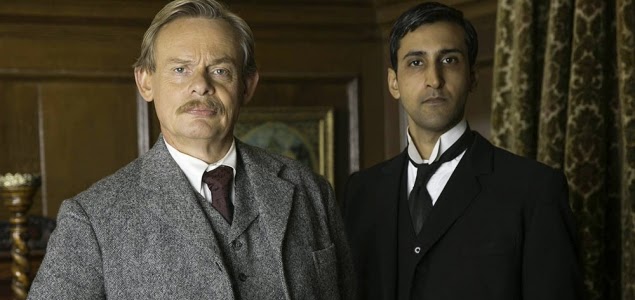
Julian Barnes's bestseller is a decade old, so fond readers may think an adaptation long overdue. This is such a fun three-parter it should have been shown at Christmas, though any case that is based on real life and involves such elements as senseless animal slaughter and racial intimidation is far from cosy. Martin Clunes does a passable Scottish accent as Sir Arthur Conan Doyle, feeling guilty and at a loose end after his long-ailing wife's death and unwilling to commit to another Sherlock Holmes adventure. Arsher Ali plays George Edalji who has served three years for killing horses under the cover of darkness, and still wants to prove his innocence.
It's a three-part ITV adaptation of a fairly hefty novel and moves quite slowly, though with some exciting Holmes-like moments. Viewers are served up pretty much what they'd expect, which in this case is a classy cast, swirling fog, comfortable middle-class Victorian homes and altogether the sort of mystery that requires only a sofa and a hot toddy to really enjoy.
Labels:
Arsher Ali,
Art Malik,
Arthur and George,
Drama,
Emma Fielding,
historical,
ITV,
Julian Barnes,
Martin Clunes,
review,
Sir Arthur Conan Doyle,
TV,
UK
Wednesday, 18 February 2015
Indian Summers
This is Channel 4's new, lavish drama about the last years of the British Raj, in the tradition of Scott's 'Jewel in the Crown' and Forster's 'A Passage to India', but without their literary sources. It's set in 1932 Simla, where the colonial ruling class retreated from the heat each summer.
Alice (Jemima West) is taking her baby by train to join her up-and-coming brother Ralph Whelan (Henry Lloyd-Hughes), having fled an adulterous husband. Ralph meanwhile has a strange mentor in Cynthia Coffin (Julie Walters), the earthy widowed owner of the Simla Club (no dogs or Indians) who uses her servant to procure American heiress Madeleine Mathers (Olivia Grant) for him. Ralph and Alice haven't seen each other since they were separated by boarding schools as children and are uneasy in their relationship. The sense of entitlement of the British and the indolence this generates contrast sharply with the busy lives of the Dalal family, where son Aafrin (Nikesh Patel) is romancing a Hindu girl and trying to make his way in the Civil Service while his sisters are involving themselves in the growing call for home rule. Two incidents - Hindustani graffiti over a portrait of the late Queen Victoria and an injured half-caste boy lying on a railway track - intrude on the struggles for survival and one-upmanship and are the portents of change. Is Ralph a focus of discontent because of what he represents, or is it something more personal?
The trailers did this no favours, since the first, extra-long episode promises a rather more subtle drama than the likes of 'Downton'. We were given a cursory introduction to the main actors ("You never told me you were Whelan's sister - he's Private Secretary to the Viceroy!" etc.) but there was enough sex and violence to be going on with and keep up the tension: brutality and illicit affairs seem to be the tropes of any Empire saga, and as 21st Century television, this doesn't shy away from exposing the moral rot that accompanied British rule on the Indian subcontinent. Will it sustain a further 9 episodes? Just possibly, and if the experience of the Himalayan foothills and bias cut dresses to a 30s soundtrack doesn't have you fiddling with the remote, you'll probably be intrigued enough to keep following along for now.
Labels:
C4,
Drama,
historical,
Indian Summers,
Julie Walters,
TV,
UK
Tuesday, 21 October 2014
The Great Fire
Forget what you learned at school. A bit of plague and Pudding Lane were rather dull anyway, weren't they? No, ITV have given this particular history lesson a 21st Century make-over. The baker is hunky Andrew Buchan, married to a comely wench (Rose Leslie) and unwittingly involved in intrigue at the highest levels. In 1666 this of-course means randy Merry Monarch Charles II (William Houston), his secretly Papist brother James and, err, Charles Dance in full sinister mode and a terrible wig. Joining him in the hirsute syrup stakes is Daniel Mays as lusty Samuel Pepys, who proves his acting chops with a convincing performance away from his usual Cockney chappies. Nonetheless, a scene where he plays posh opposite Andrew Buchan playing Cockney, with rather less success, is bizarre.
The Fire itself gets going about 40 minutes into episode 1, which gives rise to a rather unlikely Hollywood action movie sequence where Buchan rescues his daughters from their burning bakery. Here again things depart from school history, or for that matter fire awareness courses, since the Great Fire is the Slowest Fire Ever To Get Going. Even our overstuffed sofas can cause fatal conflagrations in a couple of minutes, but the incendiary bundle of naked flame, straw and timber smoulders away and kindles into the sort of flames seen in gas fire ads.
While the fire is thinking about getting going, the drama plods along in soap-like fashion. Charles has his eye on fresh young meat; a Catholic skulks about the court with a knife and the sort of sly glances that would in reality have caused his head to be parted from his torso in a flash; baker Farriner pleads with Pepys to help him out of debt; Mrs. Pepys overcomes her lack of children by learning to dance.... etc. With no spoilers necessary in any direction, we can only hope it whips up the pace before viewers start wishing the fire had been even greater, or perhaps hadn't started at all and left the characters all to succumb to the Black Death.
Labels:
andrew buchan,
Antonia Clarke,
Charles Dance,
daniel Mays,
historical,
ITV,
Perdita Weeks,
review,
Rose Leslie,
Sonya Cassidy,
The Great Fire,
TV,
UK
Sunday, 6 April 2014
The Crimson Field
2014, as the centenary of the outbreak of WWI, was obviously going to mean our screens were full of men in khaki and puttees, with women dressed as nurses amid a backdrop of mud, blood and stumpy trees. The documentaries have always been compelling, the dramas less so. This one has female leads - a sort of 'Call the Midwife' but without the babies or the NHS, and added bi-planes.
We follow a small group of new volunteers arriving at a field hospital in France, where we meet an escapee from 'Downton Abbey'. It's quite apt, since this could well be 'Downton Abbey - the Missing Years' depicting Matthew and the other Downton menfolk at the front. We feel qualified to say this, having read an account of a nurse's life at a field hospital in recent weeks. Presumably the writers have read many similar accounts, and have taken the unvarnished truth and varnished it up with a coat of 'Tenko' (all women together in a "perfectly ghastly" war), another coat of the aforementioned 'Downton' and for good measure a finishing wax of just about any WWI depiction to date ('Upstairs Downstairs', 'Aces High', 'When the Boat Comes In', 'Wings'....). This opener dealt with suspected cowardice, nascent understanding of shell shock, professional rivalries, class distinctions and the extreme youth of those involved - though the doctors' youth is unlikely to be an accurate portrayal: romantic potential in the absence of able-bodied soldiers perhaps? Each of the characters comes replete with a backstory, of-course, so the tensions are all about whether Nurse Kitty (Oona Chaplin) is a suffragette or some other freakish sort of female; whether ridiculously naive, perfume-wearing Flora is under-age; and whether Rosalie really is an old maid who only joined the war effort to escape a dull life. Oh and not forgetting whether Sister Livesey (Suranne Jones) is in fact a time-travelling flapper from the 1920s, with bobbed hair and a motorbike.
Confusingly, the original title for this was 'The Ark', which other than having a rather laboured relationship to a tale of a field hospital, presumably led viewers to think this was a televisual version of 'Noah', currently in cinemas. The episode ended with patients returning to war, rebel Kitty accepted into the fold and one patient dead in anything but a peaceful manner. Accounts of real nurses in the First World War tend to be understated, but have all the more impact for it. This is a drama, so we expect a certain amount of conflation, but would volunteer nurses really arrive at a field hospital in France without even knowing how to make a bed? We're not sure something so earnestly soapy does justice to their experiences.
Labels:
Adam James,
BBC1,
Crimson Field,
Drama,
Hermione Norris,
historical,
Kerry Fox,
Oona Chaplin,
Suranne Jones,
TV,
UK,
WWI
Friday, 13 January 2012
Drood – the Denouement
It may be limp to say it just didn’t feel right, but then, the arts are not science and there are no objective, empirical measures, so... it just didn’t feel right. All credit to Gwyneth Hughes for even trying to conclude a Dickensian tome when he’s arguably even more popular now than in his lifetime, and not known for his simplistic plots. The resolution she proposed, however, seemed a mish-mash of modern psychology (Jasper’s bad because Daddy didn’t love him) and enough coincidences to out-Dickens Dickens (not only are Drood and Jasper brothers, rather than nephew and uncle, but the Landless twins are also the product of Drood Senior’s lust). We were tempted to ask whether Ms Hughes had helped out with the recent spoof with Stephen Fry et al.
The contrivance of Edwin’s having gone to Egypt without telling anyone, therefore leaving everyone to believe him dead, and turning up again just in time to tie up all the loose ends, was less than convincing, to say the least. They may not have had email, but they did have post and even, for some of the distance, telegraph. His reputation had enjoyed something of a renaissance by then – strange how often this is the case with the dead – yet despite his growing maturity he hadn’t seen fit to bother informing anyone for the supposed year he was away?
Perhaps the main problem with finishing the creative vision of someone else, particularly when the original work is from a different era, is that it can’t be picked up from where the author left off. The externals that shaped Dickens’s thoughts are so far gone that the modern writer must rely as much on Dickens’s other novels as on history books. Had he lived, he would undoubtedly not only have finished writing but revised earlier parts of the book, perhaps making major changes, and what he left us with is by default inferior to what would have been published, had it reached that stage. There is a continuing fad for ‘additionals’, be they sequels, prequels or reimaginings, and some have more success than others but, we would argue, one of the reasons for the popularity of Dickens in this cynical, business-driven age, is his ability to take his world and from it create something new.
Labels:
Alun Armstrong,
Charles Dickens,
Drama,
Freddy Fox,
Gwyneth Hughes,
historical,
Julia McKenzie,
Matthew Rhys,
Tamzin Merchant,
The Mystery of Edwin Drood,
UK
Subscribe to:
Posts (Atom)