"That Would Never Happen!" Dan and Ali write the real reviews of UK TV drama serials (stuff marketed as quality, if you please), telling it like it is rather than the my-mate's-the-director, I-get-party-invites, or the I-need-my-job reviews that often appear. Not to mention the I've-not-watched-it....
Showing posts with label ITV. Show all posts
Tuesday, 5 July 2016
Brief Encounters
It's 1982, and on television, that means two things: lurid clothes and furnishings and 'Now that's what I call music 1' on the soundtrack. We're in Sheffield, so 'Full Monty' territory, and what follows is in the mould of those feelgood British staples. Money is tight, and where it isn't, life is boring, and these circumstances bring together four women who sell Ann Summers sex products at tupperware-style parties. The local ladies think vibrators are blenders, while the husbands and partners are threatened or bemused by this liberated behaviour.
Challenging? No. Forgettable? Yes, especially as it hasn't obvious expansion room for further series. Performed (ahem) with gusto by a decent cast, but set to inspire a summer flirtation rather than a full-on holiday romance.
Labels:
1980s,
Angela Griffin,
Ann Summers,
Brief Encounters,
Drama,
ITV,
Penelope Wilton,
Sophie Rundle,
TV,
UK
Saturday, 30 April 2016
The Secret
In 1991, Colin Howell (James Nesbitt) is a Coleraine dentist and family man whose main recreation is a bible study group, until he meets married mother Hazel Buchanan (Genevieve O'Reilly), a local teacher, at the church. She then becomes his main hobby, because, err, God meant it to happen. Of-course he did. That old nonsense about not committing adultery, indeed. The pair aren't particularly discreet, so it isn't long before their pastor (Jason Watkins) finds out and informs all parties. Forgiveness follows, and all seems well, but as Howell's wife Lesley gives birth to their fourth child, the affair starts up again. Knowing his wife is distraught, and Hazel's husband similarly upset, Colin hits on the plan to do them a favour and put them out of their misery, stage-managing a suicide pact, enabling him and Hazel to join their families together.
Too far-fetched for drama, it had to be real. Howell was convicted in 2010 of double murder, and his former lover was also convicted. They had long since split up and married other partners, who were both presumably ignorant of their spouses' bloody past. It's all rather sordid and depressing. Nesbitt is charismatic as the hypocritical happy-clappy man o'God, but the tale highlights the sorry state of a religion so out of sync with the times that a follower would rather commit murder than be seen to commit a lesser offence.
Labels:
Colin Howell,
Genevieve O'Reilly,
Glen Wallace,
ITV,
James Nesbitt,
Jason Watkins,
Laura Pyper,
review,
The Secret,
true crime drama,
TV,
UK
Wednesday, 6 April 2016
The Durrells
Seemingly as long as there is British Television there will be new adaptations of Gerald Durrell's Corfu novels, particularly 'My Family and Other Animals'. Five minutes (OK, a few years) after the last one, along comes another on ITV, with charmingly illustrated credits and a new generation of child actors . Keeley Hawes plays put-upon Mrs. D, who decides to end her dreary suburban penury in favour of eking out an existence with her four unruly children in sunny Corfu. Thanks to the book and all the previous versions, we mostly know what happens next, but there's no reason newcomers to the tale shouldn't enjoy this adaptation. That is, unless they are pedants and wonder what on earth young Margo (Daisy Waterstone) is doing sunbathing in a bikini in 1935.
Labels:
Drama,
ITV,
Keeley Hawes,
Milo Parker,
My Family and Other Animals,
review,
The Durrells,
TV,
UK
Maigret
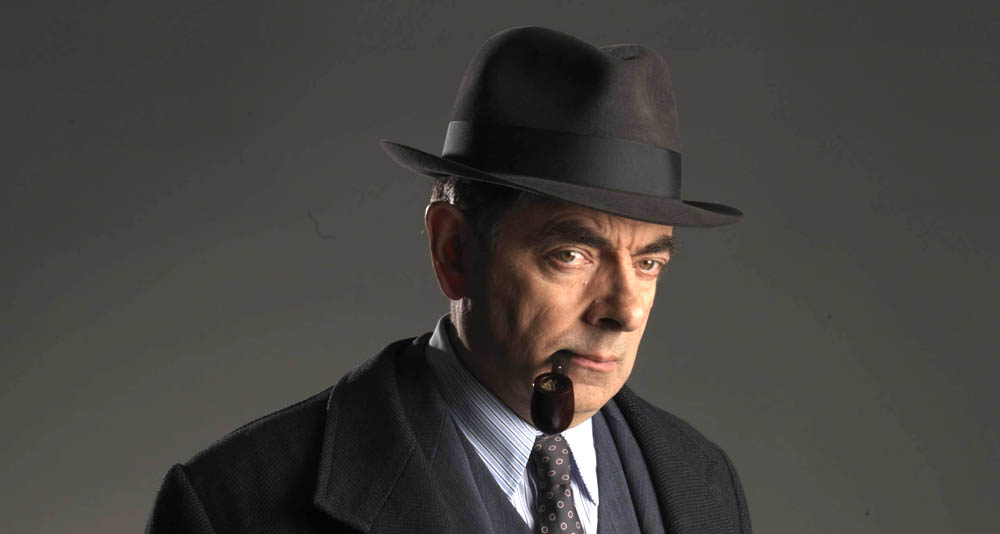
Rowan Atkinson assumes the mantel of Simenon's pipe-smoking French detective in ITV's new adaptation - the first of two - shown on Easter Monday. Atkinson wisely underplays the Inspector, but we found it hard to put Mr Bean and various Edmund Blackadders thoroughly behind us. All credit to him for those lasting creations, but it hindered our immersion in the lively, rather seedy Montmartre of the 1950s.
This story concerned that modern crime drama staple, the serial killer, and naturally the victims are women who happen to be out alone late at night. Maigret's team are stricken at their inability to catch the culprit, and threatened with being taken off the case, until the great man comes up with a daring ruse to smoke out the killer. Will it work, or go horribly wrong...?
An oddity, is all we can say. Ponderously slow except for a chase which feels like it was crowbarred into the midst of proceedings to liven things up. Most of it looked expensive, but the chase appeared to have been filmed on a camcorder. Maybe it's the nature of its dated source material, but the dialogue was as stilted as if it had been lifted directly from the French, and the interior scenes had the staged feel of a forgotten drawing-room play. A waste of a very good cast and some lovely couture.
Labels:
1950s,
Fiona Shaw,
French crime drama,
ITV,
Lucy Cohu,
Maigret,
Rebecca Knight,
Rowan Atkinson,
Shaun Dingwall,
TV,
UK
Marcella
Marcella (with a hard 'ch' rather than a soft 's' sound), is a murder squad detective who has taken a long career break to raise her children, but now finds herself abandoned by her husband and compelled back to work on her old unsolved case of - what else - a serial killer. Anna Friel has a serious line in angsty, gutsy ladies and she gives it her all here. Every modern detective needs a quirk, it seems, and Marcella's is that she loses her temper and blacks out. Not a great trait for a cop, we think, but then the team behind this were responsible for 'The Bridge. The autism spectrum was used to great effect in the character of Saga, and in today's supposedly touchy-feely police force, that's an equally unlikely asset for a detective.
It's nasty and not particularly new, but may shape up, and if Ms Friel's particular brand of angsty, gutsy character makes you reach for the remote, there is a more than decent supporting cast to distract you.
Labels:
anna friel,
crime drama,
Harry Lloyd,
Ian Puleston-Davis,
ITV,
Jamie Bamber,
Laura Carmichael,
Marcella,
Nina Sosanya,
Sinead Cusack,
The Bridge
Tuesday, 8 March 2016
Doctor Thorne
Who better to adapt one of Trollope's gossipy, class-fixated 19th Century tomes than Downton's Julian Fellowes? This in fact occupies the same 9pm, Sunday-night ITV slot lately vacated by the Crawleys, so don't expect a risk-taking, rule-breaking adaptation. Instead we get a decent cast and a handsomely-mounted hour introducing us to the eponymous Dr Thorne (Tom Hollander - confusingly the camp, bitchy Corkoran over on BBC1 at the same time) and his illegitimate niece Mary, who is in love with the handsome young squire at the big house. He returns that love, but alas has no money and must marry it. Could there be a chance that Mary's unacknowledged other uncle will bestow a fortune on her...? Fans of Trollope's novels will be either delighted or disappointed in the adaptation, but for the rest of us all that can be said is that it competently covers familiar ground.
Labels:
Anthony Trollope,
Ian McShane,
ITV,
Janine Duvitski,
Julian Fellowes,
Phoebe Nicholls,
Rebecca Front,
Richard McCabe,
Tom Hollander
Saturday, 5 March 2016
Churchill's Secret
'Elderly man isn't all that well' isn't really a revelation, but when the man in question is Prime Minister Winston Churchill (Michael Gambon), symbol of British Bull-doggedness in WWII, the news is not to be bandied about. Loyal members of his cabinet want the PM's stroke kept under wraps, lest there's an unseemly scramble for power in the absence of both Churchill and likely successor Anthony Eden (Alex Jennings), who was having gall bladder surgery abroad. Mrs. Churchill, the redoubtable-in-her-own-right Clementine (Lindsay Duncan), wants Winston away from the temptations of Westminster and brings him back home to the Kent countryside home of Chartwell. To nurse him, they contract Nurse Millie Appleyard (Romola Garai) but their peace is short-lived when the in-fighting Tories - plus ca change! - and the equally quarrelsome younger Churchills flock to Winston's bedside.
One of those 'rather nice' dramas that will go down well in America, this is a bit of a curio. The storyline runs in a similar way to 'The Madness of George III': statesman brought low, struggles of his family and the succession, slow recovery, lessons learned etc. It's beautifully filmed, some of it at Chartwell itself, now a National Trust gem, and is directed solidly by Charles Sturridge. Overall though, it's rather a byway in the great man's life, and not that one that really altered the course of his remaining decade or so. The addition of a fictional character to nurse him, who of-course happens to be from a Labour family, seems an unnecessary addition to proceedings, and merely a cypher in whom Clemmie can confide about the grief of losing her young daughter Marigold some thirty years earlier. Things only really spring to life when the children arrive and, facing their father's death, are candid about the drawbacks of growing up with parents who were almost always otherwise engaged.
Labels:
1950s,
Churchill's Secret,
Daisy Lewis,
historical drama,
ITV,
Lindsay Duncan,
Matthew Macfadyen,
Michael Gambon,
Rachael Stirling,
Romola Garai,
Tara Fitzgerald,
TV
Thursday, 7 January 2016
Jericho
The 90-minute opener fitted in brawls both male and female, a fatal accident that imperils the future of the project, theft, an accidental murder and a cover-up. All to a slightly twangy soundtrack that, if not Morricone, leans westward of York. Despite the basis in fact, this is of-course rather soapy. We have the western stock characters of pragmatic madam, slutty daughter, respected gang leader, plucky young mother, violent brute and even a rather unlikely black incomer from the real west. Well Baltimore (Clarke Peters, lately of The Wire). What is this need to re-imagine our foggy Victorian past as an Anglicised Dead Man's Gulch? Life was hard and the ironic achievement of this symbol of Britain's industrial might over the empty valley would be hard to do justice to in a drama. There are seven more episodes, so it could still go either way. Hopefully that way won't be further west.
Labels:
Christmas 2015,
Clarke Peters,
Hans Matheson,
historical drama,
ITV,
Jericho,
Jessica Raine,
Lorraine Ashbourne,
railway,
Sophie Thompson,
Yorkshire
Sunday, 3 January 2016
Beowulf: Return to the Shieldlands
Sometimes it's easier than others to write an objective review. We admit that, faced with a host of CGI monsters and dragons generic enough to have appeared in many another fantasy drama, it's difficult. The problem is that, devoid of an affinity to beasts of this sort, the fantasy tropes, or - to put it unkindly - the similarities between all the stories, render it difficult to tell them apart.
So is this good fantasy or bad fantasy? Well it's more enjoyable froth, if you like fantasy. One thing it isn't is 'Beowulf', as in the early Middle-English poem/story. As is currently common, it takes the classic as some very basic source material and weaves a new bunch of episodes around it. One thing it is, therefore, is similar to most other tales. Old warrior is waning, so young(ish) warrior prepares to assume power and undertakes a journey, but there are rivals to his claim etc. etc. It's at 7pm, so the younger kids should be in bed and the adults not yet on the sofa. We'd suggest it's not going to convert any dragon-haters, but should please dragon-lovers well enough.
Just have to say that Joanne Whalley looks great (and not mucked about with surgically, praise be). If nothing else, fantasy does at least have strong roles for mature actresses that don't require them to look either underage or like someone's great-grandmother.
Labels:
Beowulf,
historical drama,
ITV,
Joanne Whalley,
TV,
UK,
William Hurt
Friday, 1 January 2016
Harry Price Ghost Hunter
Harry Price famously investigated the 'most haunted house in England', Borley Rectory, but this finds him much earlier in his career, cheating gullible clients out of their cash by telling them what they want to hear using the technique of cold reading. When a client whom he - in the guise of the man's dead brother - has advised to be at peace takes him rather too literally and shoots himself, Price (Rafe Spall) has a rethink and begins to expose other charlatans. He is then approached by a senior Liberal (Michael Byrne), who asks for his help on behalf of the party's rising star, MP Edward Goodwin (Tom Ward). Goodwin's wife Grace (Zoe Boyle reprising the rather wan and wet type she played in a season of 'Downton Abbey') was found hysterical and naked in the middle of town, and claims she is being haunted. After Harry reluctantly begins his search, he finds more than he bargained for in terms of corporeal threats from the doting husband and the sharp-tongued parlourmaid Sarah (Cara Theobold).
ITV clearly hope this will be a series, since it ends with the formation of a partnership and the solving of the mystery. It definitely lends itself to a definition of 'enjoyable froth', and hedges its bets on the supernatural Big Q (Are there ghosts?). There are real cases to dramatise, including Borley, but here they have fictionalised, and at times rather lazily. The Goodwins are stereotypes a la 'Lady Chatterley' and their mansion is improbably grand for a former workhouse. If it becomes a TV fixture, then on the current evidence it isn't likely to blaze any trails.
Labels:
Cara Theobold,
Christmas 2015,
ghosts,
Harry Price,
historical drama,
ITV,
Michael Byrne,
Rafe Spall,
review,
Tom Ward,
UK,
Zoe Boyle
Wednesday, 28 October 2015
Jekyll & Hyde
Jekyll & Hyde, ITV's new Sunday teatime drama, is lots of fun. Written by Charlie Higson, most famous for The Fast Show, but also the writer of several gruesome thrillers for grown ups (King of the Ants), and kids (the Young Bond books), it's very pointedly not an adaptation of Robert Louis Stevenson's Strange Case of Dr Jekyll and Mr Hyde, but a new spin-off, following the life of his grandson, Robert Jekyll.
It's almost like a Alan Moore graphic novel re-imagining of the story, set in the 1930s with Robert trying to find out about his past, and battling his urges to change from his normal, mild-mannered self to the demonic Hyde. It also brings to mind 'The Incredible Hulk', with the first transformation coming about when he needs to lift a truck off a small child. (Thankfully he doesn't inflate and his clothes stay on). Higson has also thrown a bit of medicine in there, with Jekyll needing to keep taking his pills to keep the attacks at bay. It's not really much of a spoiler to say that he loses the pills pretty early on.
It's very entertaining, with some great performances particularly from Tom Bateman as Jekyll, and Richard E Grant hamming it up as the baddie Sir Roger Bulstrode, head of a murky organisation investigating the paranormal in 1930s London (we said it was a bit Alan Moore). It has been criticised for being too scary for the 6.30pm slot, and maybe it is - the bit where intruders enter Jekyll's parents' house was genuinely unsettling - but we remember being terrified by Doctor Who when we were, ahem, somewhat smaller, and he is currently on show pre-watershed on BBC1.
Some bits don't work. The very brief explanation of Jekyll's ancestry: Stevenson's Hyde had an illegitimate son, who met Jekyll's adopted father in the First World War, having fathered a child himself, which he then abandoned) is a bit convoluted and doesn't explain why Jekyll is called Jekyll, but let's not think about that too much.
Labels:
1930s,
Adaptation,
Charlie Higson,
Dr Jekyll and Mr Hyde,
Drama,
fantasy,
historical,
horror,
ITV,
Natalie Gumede,
Richard E. Grant,
Robert Louis Stevenson,
teatime,
Tom Bateman,
TV,
UK
Saturday, 10 October 2015
Unforgotten
A bit like a longer, more-involved 'Waking the Dead'... and featuring two of its stars (Trevor Eve and Claire Goose), this begins with the discovery of a skeleton by builders and follows the investigation by dogged cop DCI Cassie Stuart (Nicola Walker) and her glum DS, Sunny Khan (Sanjeev Bhaskar) into the fate and identity of the remains. Simultaneously, we are shown the lives of some families who, as becomes apparent in the last scene, are in some way linked to the murdered man.
It's gripping. Walker and Bhaskar are a genuis pairing, and both are watchable in just about anything. The supporting cast are stellar - Bernard Hill, Gemma Jones and Tom Courtenay to name three - and you sense an all-too-human tragedy lurking in the past and waiting to be dug up with the victim's body.
Any drawbacks? Cases in real life do turn on amazing luck and tiny clues, but this is sailing close to the TWNH wind in the connections made so far. (They could identify the car from a key found nearby; it only had one owner; it has survived since 1965; there was a bag in the boot!; there's a dated diary in the bag!; the ink is rendered legible by a forensic process! etc.) We're hoping that with the names of the other characters being foiund within it, no further coincidences need happen. Please.
Labels:
Benedict Taylor,
Bernard Hill,
Cherie Lunghi,
Crime,
Drama,
Gemma Jones,
ITV,
Nicola Walker,
Peter Egan,
review,
Sanjeev Bhaskar,
Tessa Peake-Jones,
Tom Courtenay,
Trevor Eve,
UK,
Unforgotten,
Zoe Telford
Saturday, 26 September 2015
Midwinter of the Spirit
A new crime series based on Phil Rickman's series of novels, with the twist that heroine Merrily Watkins (Anna Maxwell Martin) is a vicar and a trainee exorcist. Umm, that's kind of it, really, and we sat down to watch in anticipation of shivers down the spine, but the first episode didn't quite gel. The novels are set in the fictional Herefordshire town of Ledwardine and other than a few pretty shots of quaint streets, there was little sense of place. The surrounding Marches country has an attraction part way between comfy Cotswolds and wild Welsh; a perfect place, in other words, for the eye to see beauty but the mind to think of hidden forces, particularly in view of its long and often bloody history.
But no. This was mostly establishing Merrily as that most modern of Christian clerics, the laid-back, drinking, straight-talking, tolerant type. She's recently lost her husband and is doing her best for her sparky teenaged daughter, and despite being very much at the novice stage when it comes to driving out demons, is the first port of call when a man is found crucified in the woods. Oh and when another priest starts acting very strangely and can't comfort a dying man in a hospital. The dying man has freaked out the nurses, and when he gets hold of Merrily, rather literally, he almost frightens the faith out of her. There are the usual upside-down crosses, shrine rooms with pentangles and goat skulls and lots of mentions of evil, but it's all feeling rather disjointed and muddled so far. Let's hope David Threlfall as Merrily's seen-it-all exorcist coach can sort things out.
Labels:
Adaptation,
Anna Maxwell Martin,
David Threlfall,
Drama,
horror,
ITV,
Midwinter of the Spirit,
Phil Rickman,
review,
TV,
UK
Tuesday, 1 September 2015
The Trials of Jimmy Rose
In the first of this three-parter, Jimmy Rose (Ray Winstone) is released after a twelve-year stretch and returns home to find his family less than overjoyed to see him.
Despite the familiar premise, this is actually pretty good. Ray Winstone's strength as an actor is in showing his characters' vulnerability, as true when he was a young tearaway in 'Scum' as it is here. It's not clear what crimes he committed, to get a ten and then a twelve-year sentence, but he has a nice house, a lovely wife, two grown children, grandchildren and a good friend. In his bear-like pacing about his home, it's clear how lonely and frustrating it must be to rejoin a life lived without you for a dozen years. His wife is clearly angry with him and unsure of their future, his son doesn't want to know him, his granddaughter has taken up drugs and her drug dealer, and smart phones are a mystery. (Would they be? Phones are officially banned in prisons, but....) Anyway, Jimmy is determined to get back his family and self-respect, and it's clear that his trials have only just begun.
Labels:
Amanda Redman,
Drama,
ITV,
Ray Winstone,
review,
Trials of Jimmy Rose,
TV,
UK
Monday, 4 May 2015
Home Fires
Ever wondered how the Women's Institute came to be associated with jam? Nor did we, but it's apparently because a rebel group of nice women in Great Paxford stood up to their snooty leader and formed a breakaway branch, and their first act of defiance (jam being rather common) and towards the soon-to-be-declared war effort, was denuding all the local blackberry bushes of fruit and making a squillion pots of sweet sandwich filling. This is based on a non-fiction book, 'Jambusters', and you can see the boxes ticked by commissioning editors here: WWII for the nostalgia, strong roles for women etc.
Watching this a few days after 'Anzac Girls', it's striking how by-numbers they both are: haughty toff, nice toff, man-hungry girl and even the One with a Secret turn up again here, though this time it's a man, Ed Stoppard, who as the local doctor, Will Campbell, is set to abandon his patients' hernias and whooping coughs and head for the rugged plains of war. Alas for him, his nasty smoking habit has given him lung cancer, so he won't be going anywhere. Tsk tsk. Then there's redoubtable Pat Simms (Claire Rushbrook), abused by her writer husband Bob (Mark Bazeley) and determined to keep it a secret, she poisons his pilchards. Alas for her, she hasn't put enough in....
It's all very Sunday night - as opposed to 'The C Word', broadcast on BBC1 at the same time - and has a strong cast that includes Francesca Annis, Samantha Bond, Ruth Gemmell, Frances Grey, Fenella Woolgar and Anthony Calf. There may be trouble ahead, as the song goes, but while there's the WI, the women of Great Paxford won't find WWII too unbearable, and nor will viewers wanting to unwind on a Sunday evening.
Labels:
Drama,
Ed Stoppard,
Francesca Annis,
Home Fires,
ITV,
Ruth Gemmell,
Samantha Bond,
TV,
UK,
women,
WWII
Tuesday, 21 April 2015
Safe House
"It's okay, they're saying we might be the new 'Broadchurch'."
The clue is in the title, since the drama would be a pretty poor one if the house was actually safe. Robert (Christopher Eccleston) is an ex-cop who had a breakdown after a woman he was protecting was shot in the street. He has renounced policing and has restored a remote, grim old house with his wife (Marsha Thomason) and has made a new life for himself running a B&B, acquiring enough friends to make a decent birthday party and swimming in the lake without a thought of Weil's disease. When his wife invites his ex-colleague (Paterson Joseph) to visit their idyll, Robert is persuaded to allow his house to be used as a 'safe house', protecting vulnerable witnesses. (This might not seem like a good idea, but characters in dramas are not to be dissuaded, and Robert does at least show a nifty line in evading a pursuer in a car chase.)
A mum (Nicola Stephenson), her young son and teenaged stepdaughter arrive at the house after the boy was the victim of an attempted kidnapping which hospitalised his father (Jason Merrells). Blackpool Pleasure Beach seems a rather odd choice for an abduction, and either the child mysteriously didn't scream or the crowds just ignored a child in peril as the bearded villain made off with him. It's clear the man knew the dad, who came after him and was getting a kicking when a motorist, presumably an innocent bystander, waded in to help and was subsequently stabbed. Recovering in hospital, dad is stunned to hear that the stabbed victim has died and shockingly reluctant to accept help from the police. Could this have something to do with his student son, who is AWOL and clearly involved in something dodgy?
This is one of those dramas that ratchets up the tension consistently and throws in just enough backstory to keep things interesting, the risk being that the pay off has to be pretty strong to make it all worthwhile. No wishy-washy, or wildly unlikely, explanations for the action are going to satisfy viewers who have given four episodes of their time (time may as well be measured in episodes as in minutes, or coffee spoons). We are rooting for it, having sat through one, and if it must be compared to 'Broadchurch', please let it be series one and not series two.
Labels:
Christopher Eccleston,
Crime,
Drama,
ITV,
Jason Merrells,
Marsha Thomason,
Nicola Stephenson,
Paterson Joseph,
review,
Safe House,
Sarah Smart,
TV,
UK
Tuesday, 7 April 2015
Code of a Killer
Catching criminals by DNA profiling seems so embedded in modern policing that it's astonishing to think it has only been a procedure at all since 1986, when DCS Baker (David Threlfall, having survived the flood as Noah) approached Alec Jeffreys (John Simm) at Leicester University to see if his pioneering work in genetic fingerprinting could help him catch the rapist and killer of two local women.
It's perhaps surprising that this case has taken so long to appear as a dramatisation, given it has the worthy 'breakthrough' element ('Breaking the Mould', 'Longitude') as well as a real-life serial killer (e.g. 'Appropriate Adult', 'See No Evil', 'This is Personal') and tried and trusted formulas are beloved of TV commissioners. Watching this, though, we couldn't help but wonder whether it wouldn't have been better as a straightforward documentary account. It has all the hallmarks of a police procedural, and we know the outcome, so it's a bit like watching a repeat of an episode of 'Lewis'.
There's mild interest when a young suspect comes forward to confess to one of the killings, but not the other, and is found innocent of both by way of his DNA comparison to that found on the victims. That aside, though, this wasn't a case that grabbed the headlines for reasons of macabre methods, unlikely perpetrator or sheer numbers, and while the lab stuff is explained clearly enough for the lay audience, it isn't thrilling enough to sustain what will end up being over two hours of television. Nor, at the other end of the scale, did it delve into the human drama of the victims' families ('Five Daughters'). Why cast the wonderful Dorothy Atkinson as Dawn Ashworth's mother? So far she has had little to do but look distressed in a couple of scenes.
Finally, we are sorry to say that it wasn't imaginatively written and produced. The 1983 setting is indicated by drab clothes, 70s wallpaper and a car stereo blaring 'Karma Chameleon'; the discovery of a body is shot in slow motion; Jeffreys' obsessive geekdom is indicated by his ignorance of The Smiths and his forgetting both a family wedding and his daughter's school play. Since taking licence with the facts would be in poor taste here, we can only conclude that it wasn't a great choice for dramatisation after all. The science, which is remarkable, has changed the course of many lives and will continue to do so, and Professor Jeffreys has received a deserved knighthood for his discoveries. Some great stories tell themselves without the need for script and actors.
Labels:
Andrew Tiernan,
Anna Madeley,
Code of a Killer,
Crime,
David Threlfall,
DNA,
Drama,
ITV,
John Simm,
Lorcan Cranitch,
Paul Copley,
review,
Robert Glenister
Sunday, 8 March 2015
Poldark
If you like your swashes buckled, your bodices ripped and your upper lips stiff as you like, you really are spoiled for choice on UK TV at the moment, with the 'Musketeers', 'Banished', 'Arthur and George', 'Indian Summers' and 'Mr. Selfridge' all jostling with each other in the schedules, and now, going head-to-head on a Sunday with two of the above, comes 'Poldark'. (That's pronounced 'PolDARK' btw, with the emphasis on the last syllable, Cornish-style.) The series of eight episodes is based on the first two of Winston Graham's novels which form an epic family saga of late 18th Century tin mine-owning squires. Several were filmed in the mid 1970s and that adaptation, staring Robin Ellis and Angharad Rees, retains a fan following so devout that an attempt in the late 90s at a sequel following the next generation (but without any of the original stars) sank without trace.
Galloping up, then, is Aidan Turner, who admittedly looks the part to the extent that you wonder why he hasn't already been cast as Heathcliff, Mr. Rochester and every other brooding hero you care to name. Turner plays the eponymous Ross Poldark, newly returned in defeat from the American War of Independence, to find his once-prosperous home and mines gone to wrack and ruin after his father's death. Thinking Ross lost in the war, his fiance Elizabeth (Heida Reed) has got engaged to his drippy cousin Francis (Kyle Soller), none of which turns Poldark from a brooder into a cheery chap. This first episode sees him rescuing young tomboy Demelza Carne (Eleanor Tomlinson) and suffering the violent repercussions of her brutish kinfolk; meanwhile he vacillates about whether to make something of his dwindled inheritance or leave the crashing Cornwall waves behind him.
So, will this be as popular as the '70s version? Almost certainly not, but that has as much to do with the multitude of channels and viewing-on-demand available now. Times have changed in other ways too - the original saw Sunday evening church services in abeyance because parishioners were apparently glued to the screen. This is a perfectly respectable adaptation of Graham's original prose, and so far faithful to the previous TV version too. It's also good Sunday evening hokum with a cracking cast and that lovely wild coastline as a backdrop. It's a worthy last job for the late Warren Clarke as Uncle Charles Poldark, and Ruby Bentall finally steps out of dim-girl roles as the centre of gravity of the piece, Ross's cousin Verity. (There's also an improvement, in the persons of Beatie Edney and Phil Davis as Prudie and Jud, whose every appearance in both book and previous version had the attention wandering.) If they keep up this standard, we hope they go on to become a Sunday staple. After all, this has the blessing of the previous Ross, Robin Ellis, who makes a cameo appearance in the series.
Labels:
Aidan Turner,
BBC1,
Beatie Edney,
Eleanor Tomlinson,
Heida Reed,
historical,
ITV,
Jack Farthing,
Kyle Soller,
Phil Davis,
Pip Torrens,
Poldark,
Robin Ellis,
Ruby Bentall,
Warren Clarke,
Winston Graham
Monday, 2 March 2015
Arthur and George
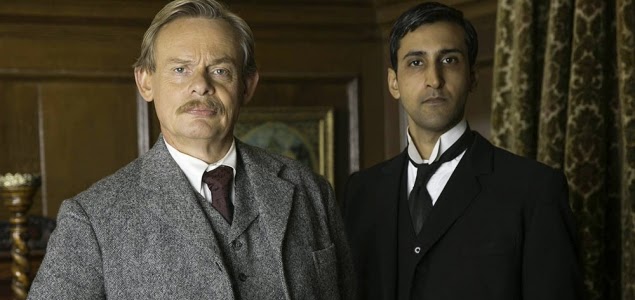
Julian Barnes's bestseller is a decade old, so fond readers may think an adaptation long overdue. This is such a fun three-parter it should have been shown at Christmas, though any case that is based on real life and involves such elements as senseless animal slaughter and racial intimidation is far from cosy. Martin Clunes does a passable Scottish accent as Sir Arthur Conan Doyle, feeling guilty and at a loose end after his long-ailing wife's death and unwilling to commit to another Sherlock Holmes adventure. Arsher Ali plays George Edalji who has served three years for killing horses under the cover of darkness, and still wants to prove his innocence.
It's a three-part ITV adaptation of a fairly hefty novel and moves quite slowly, though with some exciting Holmes-like moments. Viewers are served up pretty much what they'd expect, which in this case is a classy cast, swirling fog, comfortable middle-class Victorian homes and altogether the sort of mystery that requires only a sofa and a hot toddy to really enjoy.
Labels:
Arsher Ali,
Art Malik,
Arthur and George,
Drama,
Emma Fielding,
historical,
ITV,
Julian Barnes,
Martin Clunes,
review,
Sir Arthur Conan Doyle,
TV,
UK
Monday, 15 December 2014
The Lost Honour of Christopher Jefferies
In ‘The Lost Honour of Katharina Blum’, Heinrich Boll’s
eponymous heroine has a romantic encounter with a man who is wanted by the
police, is vilified by the tabloid press and shoots the reporter responsible;
summary justice of the kind not advocated by the Leveson Inquiry. Writer Peter Morgan draws parallels between
the fictional victim of press intrusion and Christopher Jefferies, who was an
early suspect in the December 2010 murder of landscape architect Joanna Yeates. There are two crucial differences to Boll's
story, however. One is that Jefferies was an
entirely innocent victim and the second is that the press used his unusual
appearance and other personal lifestyle choices as indicators of deviant
tendencies.
Real-life reconstructions are hazardous. Where and how are lines of taste drawn? There has been criticism of the focus on
Jefferies rather than on Jo Yeates, whose life wasn’t just changed but ended in
December 2010. Was it appropriate to use news
footage of Ms. Yeates’ parents as they appealed to the public to help find
their missing daughter? ITV chose to
show this drama over three hours on two consecutive nights (with multiple ad
breaks) and at times, in a purely dramatic sense, it plodded along. Jason Watkins as Jefferies gives a career-high
performance as the man whose combover almost landed him in the dock, but there
was a definite sense of Morgan and Roger Michell, the director, trying too hard
to portray him as the Great English Eccentric, who inspired devotion in
ex-pupils and whose curmudgeonly tendencies disguised a warm and noble heart. Jefferies may be the sort of person whose
bakery gives him free loaves for a month in order to lure his return as a
customer, but highlighting this made it dangerously close to the black/white
character summaries of which the press is so often guilty.
In case we were in any doubt, there was Steve Coogan’s
fictionalised meeting with Jefferies while waiting to appear before the Leveson
Inquiry, in which they discussed press intrusion, but for us (well, not for
Dan, whose recurring nightmare is in fact being wrongly imprisoned) this got to
the real heart of the matter. Is it
justifiable to invent a meeting in a drama based on a real-life case that is
all about truth, distorted interpretations of the truth and downright
lies? The only dramatic point that this
scene made was not that Jefferies’ appearance drew suspicion upon him, but the
fact that he was not a celebrity: Coogan’s wild coiffure wasn’t even remarked
upon. What was referred to in the drama
as the renowned English tolerance, even celebration, of eccentrics seems more
to us like western society’s double standards.
Howard Hughes (and perhaps also the late Michael Jackson) minus millions would be less a figure of mystery than a
hospital inmate. The press tend to draw
characters around the plot, describing any victim as the most promising, loved person
cut down in their prime or before they could flower, and any culprit as having
shown obvious signs of cruel and criminal intentions in their introvert
behaviour or choice of sombre reading material.
Jefferies was a victim of our sensation-seeking, which essentially
encourages journalists to appeal to mass ignorance. Ironically, as a committed teacher, it’s
something he’s battled against for most, if not all, of his career.
Labels:
Anna Maxwell Martin,
Christopher Jefferies,
Crime,
Drama,
ITV,
Jason Watkins,
Lost Honour,
Peter Morgan,
Roger Michell,
Steve Coogan
Subscribe to:
Posts (Atom)