22.11.63 is an 8 part series from Stephen King (who wrote the original book) and JJ Abrams (producing), that deals with a man travelling back in time to prevent the assassination of JFK.
All time travel shows depend on a) the means of travelling back in time, and b) the rules you need to obey once you get there. Here it's pretty clunky - the means is a cupboard in a diner, and the rules are that i) you end up at the same time and place as a starting point each time, ii) that 2 minutes passes no matter how long you spend in the past, and iii) if you try to change history bad things happen.
The central premise is good, and apparently King thought of it in the early 70s. However it seems rooted in the past, because surely an American man in the 2010s would actually want to go back to stop 9/11 and the Gulf War, rather than keep JFK alive and (supposedly) then stop Vietnam.
It looks very glossy, and clearly has had lots of money spent on it. Why have one vintage car from the 1950s to set the scene when you can have about 30 parked up?
At this point, Dan's will to blog gave out. He didn't watch beyond episode one. Enough said.
Showing posts with label Crime. Show all posts
Showing posts with label Crime. Show all posts
Wednesday, 22 June 2016

Saturday, 19 March 2016
Follow the Money

The latest Saturday night Scandi offering from BBC4 is 'Follow the Money', which is less a noir than a conspiracy thriller. The Corporates Dun Bad again, and this being the 21st Century and Denmark, the Bad Corporates are in supposedly sustainable, clean, renewable, green energy. The adjectives may seem superfluous, but apparently they don't all mean the same thing, and they are anything but clean in the hands of Sanders, whose company Energreen has a wind turbine empire staffed by itinerant workers too scared to refuse to work in unsafe conditions.
Meanwhile nice cop Mads is on the case of one of them who turns up dead, and his efforts to convince his father to talk result in the father's death too. Luckily, a colleague in the fraud squad turns up to rescue him from the gloom and guilt - and the similar feelings engendered by his wife's MS - and they embark on an investigation which encompasses Sanders' ambitious new head lawyer and, we suspect, will eventually engulf the mechanics with criminal sidelines.
This is shaping up well, albeit not along unexpected lines. We're hoping for some moral grey areas writ large over the next month.
Sunday, 14 February 2016
Trapped

Extreme Scandi alert! Danish heavyweights be warned - the Icelanders are on the case. Sharp-eyed viewers may recognise the ship's captain from both 'The Killing' and 'Borgen' but you know Iceland must be small if Denmark embodies the big, bad, criminal nation.
The latest in the BBC4 foreign drama slot is no advertisement for the cold little country, however. Not only does a dismembered torso turn up in some fishing nets (check your fish finger sandwich very carefully) at the same time as a Lithuanian trafficker who bears an uncanny resemblance to Rasputin, but the kind of storm is blowing which has even the hardly Icelanders looking doubtfully at their snow chains and opting for a cuppa. Grumpy bear of a policeman Andri (Olafur Darri Olafsson) is called in, and in the best tradition of crime dramas, he has a troubled private life to think about, with his estranged wife showing up for the weekend with a new boyfriend.
The title presumably refers to everyone being trapped in the small coastal town - even the pathology team are trapped in comparatively comfy Reykjavik - so if claustrophobia is your thing, you can wallow in ten episodes shown in five parts. Sort of like a very long drawn out Agatha Christie. It manages to keep up the tension over the first two episodes, but not without some TWNHs on the way. Would a prisoner be allowed out of the cell to go to the toilet, with only one guard? Wouldn't there be facilities in the cell, or two on duty? No prizes for guessing what ensues.... And would the children run off in a snowstorm when it's dark and the weather is so bad they can't see a yard in front of them? It all feels a little contrived to drag the thing out.
Saturday, 26 December 2015
And Then There Were None

The best-selling mystery novel of all time, apparently. A rather hoary old stage chestnut is now brought to the Boxing Day table with its revised PC title, but most of its other thirties prejudices intact. A group of disparates are summoned to 'Soldier Island' off the Devon coast for a rendezvous billed as a dinner party. In the comfortable but eerily deserted environs of the island's hotel, they hear a recorded broadcast accusing them all of committing (separate) murders. By the end of the hour there were eight of the ten remaining alive.
Just about as perfect a holiday drama as you could wish for, following in the wake of this year's successful play adaptations of classics. Rather darker somehow than the Poirots or Marples, and went down very well with a tipple.
Thursday, 15 October 2015
River

Remember 'The Sixth Sense'? "I see dead people." If the boy had somehow grown up to be Stellan Skarsgard and become a UK detective, this would be his continuing story. DI John River is accompanied by his recently deceased Sergeant 'Stevie' Stevenson (Nicola Walker, also pleasing the crowds in 'Unforgotten' over on ITV). Stevie straightens him out, jollies him up and keeps him going. Sadly for River, he also manages to accrue the ghost of the young man he suspected of Stevie's killing, whom he has chased to his death from a tower block balcony. He wants his name cleared. Then there's the subject of the book River is reading, one Thomas Neill Cream (Eddie Marsan), the Lambeth Poisoner, who hanged for his crimes in 1892 and imparts his macabre philosophy.
Given his array of dead head-friends, it's amazing he manages any work at all, but his boss, DCI Chrissie Read (Lesley Manville) states that his clear-up rate is 80%. That could of-course be down to the fact that the victim drops by to give him a nudge, as in this week's case of a girl whose boyfriend is accused of her murder.
It's sad and it's funny. There's a matter-of-factness about the talking dead for River, while his interactions with the living at work force you to remember that he's in danger of a breakdown. In fact, talking dead aside, the main TWNH is that even solving 80% of cases wouldn't save him from an enforced period of rest when colleagues have witnessed him talking to and even punching people who don't exist. Morgan's writing can be great, so we're hoping for something of substance. There are comparisons to Scandi noir, but this is no 'Wallander' or 'The Killing', and none the worse for that. We were reminded in his recall of his late colleague of the scenes of Craven and his murdered daughter in 'Edge of Darkness'. If it maintains the edge, rather than skipping into vacuous light or tumbling wholesale into darkness, this could be among the best dramas this year.
Honorary mention for Adeel Akhtar as Rivers' new DS, Ira King. He was so good as Wilson Wilson in 'Utopia', we were shocked to see him with two good eyes.
Saturday, 10 October 2015
Unforgotten

A bit like a longer, more-involved 'Waking the Dead'... and featuring two of its stars (Trevor Eve and Claire Goose), this begins with the discovery of a skeleton by builders and follows the investigation by dogged cop DCI Cassie Stuart (Nicola Walker) and her glum DS, Sunny Khan (Sanjeev Bhaskar) into the fate and identity of the remains. Simultaneously, we are shown the lives of some families who, as becomes apparent in the last scene, are in some way linked to the murdered man.
It's gripping. Walker and Bhaskar are a genuis pairing, and both are watchable in just about anything. The supporting cast are stellar - Bernard Hill, Gemma Jones and Tom Courtenay to name three - and you sense an all-too-human tragedy lurking in the past and waiting to be dug up with the victim's body.
Any drawbacks? Cases in real life do turn on amazing luck and tiny clues, but this is sailing close to the TWNH wind in the connections made so far. (They could identify the car from a key found nearby; it only had one owner; it has survived since 1965; there was a bag in the boot!; there's a dated diary in the bag!; the ink is rendered legible by a forensic process! etc.) We're hoping that with the names of the other characters being foiund within it, no further coincidences need happen. Please.
Sunday, 30 August 2015
The Pinkertons

A series based on the real-life cases of the Pinkertons' National Detective Agency sounds like a good idea. Allan Pinkerton, here played by our own Angus MacFadyen, founded the first major detective firm in America, joined after the American Civil War by his rough and ready son William (Jacob Blair) and Kate Warne (Martha MacIsaac) as the first female detective, whose modern ways incline towards what we would term forensics.
A good premise alone does not a good series make, however. It needs decent writing, a fair cast and reasonable production values. This lacks two, and the third is compromised by the lack of the rest. This is Canadian, and we have to say that if Canada feels superior to its southern neighbour, it's not justified by the television they sell to us. You might expect Canada to try producing the likes of 'Mad Men', 'The Wire' and 'Breaking Bad', but this feels more like 'Bonanza' or 'The High Chaparral' with slightly less slush and more brutality. With a banal script and looking bizarrely like it was filmed on a hand-held camcorder by a tourist at a wild west show, the fascination was in watching the actors battle to gain even an ounce of verisimilitude. MacFadyen, who has presence and delivered some good performances in his back catalogue, sounds like he is putting on an accent even though Scottish is presumably second if not first nature.
Anachronisms are inevitable, no matter how small and despite all efforts at attention to detail, but the 'CSI 19th Century' franchise is much better served by 'Ripper Street', in the form of Captain Jackson, and even by Canada's own 'Murdoch Mysteries', which at least has charm and a modicum of tension, even if the female pathologist clearly races back and forth a hundred years between each episode. This Pinkertons tale of bushwhackers was curiously bloodless, and the buddy banter failed to establish any rapport between the characters. Crime and the Old West, on this occasion, are not a great combination.
Friday, 31 July 2015
Partners in Crime

Tommy (David Walliams) and Tuppence (Jessica Raine) are a couple who embark on amateur detective adventures in the 1950s in this BBC adaptation of Agatha Christie's dwarfed-by-Poirot/Marple novels. For the three people remaining in the English-speaking world who still haven't heard of Dame Agatha Mary Clarissa, she had a mind for murder like few others, and millions have whiled away a cosy afternoon or evening reading about stabbings, strangulation and poison. Murder may appeal, but coupled with 1930s or 1950s settings and costumes and the attendant traditional trappings of a country house, or a steam train, and the mysteries are irresistible to large swathes of the population. Readers and viewers don't expect too much gore, and hardly any realism at all, and they are rarely disappointed.
'Partners in Crime' will have pleased its target audience, we think it fair to say. Dan is not fond of the elderly lady with the knitting, nor ze little man wiz ze grey cells, but even he found this watchable and has made a note for Sunday evenings. The nonsense plot, as always, turns on rather unlikely coincidences and some deeply unpleasant types, but the Beresfords are enjoyably batty - even if Walliams is too Walliams to be entirely Tommy - and good on the writers to keep them of their time in their so-hideous-it's-wonderful interior design and their boarding-school son. The script has (adds?) a soupcon of wit, Jessica Raine is wonderful as Tuppence and the production looks gorgeous. Is the licence fee worth it? How can you ask?! We're already hoping for a Christmas special.
Thursday, 11 June 2015
The Interceptor

Terrible title, cliched show. Actually we're not even sure we can say anymore about this. Dedicated, maverick Ash is a customs officer recruited to a crack-but-shadowy team who go after the big criminals rather than the small fry they usually manage to catch at borders. Dialogue by numbers, some who-cares chases and some gadgets had us tuned out halfway through. We suffer for our blog, but only within limits.
Tuesday, 21 April 2015
Safe House

"It's okay, they're saying we might be the new 'Broadchurch'."
The clue is in the title, since the drama would be a pretty poor one if the house was actually safe. Robert (Christopher Eccleston) is an ex-cop who had a breakdown after a woman he was protecting was shot in the street. He has renounced policing and has restored a remote, grim old house with his wife (Marsha Thomason) and has made a new life for himself running a B&B, acquiring enough friends to make a decent birthday party and swimming in the lake without a thought of Weil's disease. When his wife invites his ex-colleague (Paterson Joseph) to visit their idyll, Robert is persuaded to allow his house to be used as a 'safe house', protecting vulnerable witnesses. (This might not seem like a good idea, but characters in dramas are not to be dissuaded, and Robert does at least show a nifty line in evading a pursuer in a car chase.)
A mum (Nicola Stephenson), her young son and teenaged stepdaughter arrive at the house after the boy was the victim of an attempted kidnapping which hospitalised his father (Jason Merrells). Blackpool Pleasure Beach seems a rather odd choice for an abduction, and either the child mysteriously didn't scream or the crowds just ignored a child in peril as the bearded villain made off with him. It's clear the man knew the dad, who came after him and was getting a kicking when a motorist, presumably an innocent bystander, waded in to help and was subsequently stabbed. Recovering in hospital, dad is stunned to hear that the stabbed victim has died and shockingly reluctant to accept help from the police. Could this have something to do with his student son, who is AWOL and clearly involved in something dodgy?
This is one of those dramas that ratchets up the tension consistently and throws in just enough backstory to keep things interesting, the risk being that the pay off has to be pretty strong to make it all worthwhile. No wishy-washy, or wildly unlikely, explanations for the action are going to satisfy viewers who have given four episodes of their time (time may as well be measured in episodes as in minutes, or coffee spoons). We are rooting for it, having sat through one, and if it must be compared to 'Broadchurch', please let it be series one and not series two.
Tuesday, 7 April 2015
Code of a Killer

Catching criminals by DNA profiling seems so embedded in modern policing that it's astonishing to think it has only been a procedure at all since 1986, when DCS Baker (David Threlfall, having survived the flood as Noah) approached Alec Jeffreys (John Simm) at Leicester University to see if his pioneering work in genetic fingerprinting could help him catch the rapist and killer of two local women.
It's perhaps surprising that this case has taken so long to appear as a dramatisation, given it has the worthy 'breakthrough' element ('Breaking the Mould', 'Longitude') as well as a real-life serial killer (e.g. 'Appropriate Adult', 'See No Evil', 'This is Personal') and tried and trusted formulas are beloved of TV commissioners. Watching this, though, we couldn't help but wonder whether it wouldn't have been better as a straightforward documentary account. It has all the hallmarks of a police procedural, and we know the outcome, so it's a bit like watching a repeat of an episode of 'Lewis'.
There's mild interest when a young suspect comes forward to confess to one of the killings, but not the other, and is found innocent of both by way of his DNA comparison to that found on the victims. That aside, though, this wasn't a case that grabbed the headlines for reasons of macabre methods, unlikely perpetrator or sheer numbers, and while the lab stuff is explained clearly enough for the lay audience, it isn't thrilling enough to sustain what will end up being over two hours of television. Nor, at the other end of the scale, did it delve into the human drama of the victims' families ('Five Daughters'). Why cast the wonderful Dorothy Atkinson as Dawn Ashworth's mother? So far she has had little to do but look distressed in a couple of scenes.
Finally, we are sorry to say that it wasn't imaginatively written and produced. The 1983 setting is indicated by drab clothes, 70s wallpaper and a car stereo blaring 'Karma Chameleon'; the discovery of a body is shot in slow motion; Jeffreys' obsessive geekdom is indicated by his ignorance of The Smiths and his forgetting both a family wedding and his daughter's school play. Since taking licence with the facts would be in poor taste here, we can only conclude that it wasn't a great choice for dramatisation after all. The science, which is remarkable, has changed the course of many lives and will continue to do so, and Professor Jeffreys has received a deserved knighthood for his discoveries. Some great stories tell themselves without the need for script and actors.
Monday, 15 December 2014
The Lost Honour of Christopher Jefferies

In ‘The Lost Honour of Katharina Blum’, Heinrich Boll’s
eponymous heroine has a romantic encounter with a man who is wanted by the
police, is vilified by the tabloid press and shoots the reporter responsible;
summary justice of the kind not advocated by the Leveson Inquiry. Writer Peter Morgan draws parallels between
the fictional victim of press intrusion and Christopher Jefferies, who was an
early suspect in the December 2010 murder of landscape architect Joanna Yeates. There are two crucial differences to Boll's
story, however. One is that Jefferies was an
entirely innocent victim and the second is that the press used his unusual
appearance and other personal lifestyle choices as indicators of deviant
tendencies.
Real-life reconstructions are hazardous. Where and how are lines of taste drawn? There has been criticism of the focus on
Jefferies rather than on Jo Yeates, whose life wasn’t just changed but ended in
December 2010. Was it appropriate to use news
footage of Ms. Yeates’ parents as they appealed to the public to help find
their missing daughter? ITV chose to
show this drama over three hours on two consecutive nights (with multiple ad
breaks) and at times, in a purely dramatic sense, it plodded along. Jason Watkins as Jefferies gives a career-high
performance as the man whose combover almost landed him in the dock, but there
was a definite sense of Morgan and Roger Michell, the director, trying too hard
to portray him as the Great English Eccentric, who inspired devotion in
ex-pupils and whose curmudgeonly tendencies disguised a warm and noble heart. Jefferies may be the sort of person whose
bakery gives him free loaves for a month in order to lure his return as a
customer, but highlighting this made it dangerously close to the black/white
character summaries of which the press is so often guilty.
In case we were in any doubt, there was Steve Coogan’s
fictionalised meeting with Jefferies while waiting to appear before the Leveson
Inquiry, in which they discussed press intrusion, but for us (well, not for
Dan, whose recurring nightmare is in fact being wrongly imprisoned) this got to
the real heart of the matter. Is it
justifiable to invent a meeting in a drama based on a real-life case that is
all about truth, distorted interpretations of the truth and downright
lies? The only dramatic point that this
scene made was not that Jefferies’ appearance drew suspicion upon him, but the
fact that he was not a celebrity: Coogan’s wild coiffure wasn’t even remarked
upon. What was referred to in the drama
as the renowned English tolerance, even celebration, of eccentrics seems more
to us like western society’s double standards.
Howard Hughes (and perhaps also the late Michael Jackson) minus millions would be less a figure of mystery than a
hospital inmate. The press tend to draw
characters around the plot, describing any victim as the most promising, loved person
cut down in their prime or before they could flower, and any culprit as having
shown obvious signs of cruel and criminal intentions in their introvert
behaviour or choice of sombre reading material.
Jefferies was a victim of our sensation-seeking, which essentially
encourages journalists to appeal to mass ignorance. Ironically, as a committed teacher, it’s
something he’s battled against for most, if not all, of his career.
Tuesday, 28 October 2014
The Missing *spoilers*

Neither an original title nor plot - Tony and Emily Hughes' five-year-old son Ollie goes missing while they are on holiday in France in 2006 and in 2014 he still hasn't been found. Not unlike true cases - the McCanns immediately spring to mind - this pieces together the loss and immediate aftermath of the disappearance in tandem with Tony's (James Nesbitt) continuing search for his missing son. Emily (Frances O'Connor) has seemingly moved on with her life, away from her husband and in with one of the policemen assigned to the case, and his son, who is unnervingly close in age to that of Ollie. In this, the first of eight episodes, Tony re-enlists the help of a reluctant French detective from the original case to follow up a new lead.
It's gripping and the performances are great. We felt the Hughes' pain as they searched in vain for their missing little boy and also the wariness of the local population in dealing with this old case which brought so much unwelcome publicity to the town. What makes us slightly wary, however, is how far credulity will stretch over an eight-hour run. How many red herrings must we swallow and will there be an ending to justify the hours of watching? That's to say, there's only room on the airwaves for one 'Amber'. There were also rather unlikely plot points: a second-hand clothes shop owner who recorded the names and contact details of all those who donated items? A family who returned home from holiday and didn't notice graffiti on their cellar wall or a scarf that didn't belong to any of them?
We're hoping these minor quibbles are not the precursors of major ones. It was a good start but there's a long road ahead, every Tuesday 'til Christmas.
Monday, 6 October 2014
Grantchester

This is one of those fluffy-robe-and-slippers dramas to cosy up to of an autumn evening. It's set in the nice, safe 1950s and has such a nostalgic glow it's almost sepia-toned. Those who remember the 1950s may be scratching their heads at the likes of this, but along with 'Call the Midwife' and 'Quirke' it ticks a plethora of boxes for maximum appeal. Here we have a kindly, lovelorn young vicar (James Norton, whom we recently saw cold-bloodedly raping and killing as Tommy in 'Happy Valley') who befriends a kindly, careworn old cop (Robson Green, taking a break from angling) to solve murders in the titular sleepy English town.
This first story, based one of James Runcie's books, has a supposed suicide whom his mistress suspects was murdered. She's a suspect, of-course, as is his melancholy German widow, his business partner and his secretary.
Nothing new in the plot, so what about our hero? A former soldier in the war who drinks whisky, smokes, has a crush on a girl who's now engaged to someone else and loses at backgammon. Oh and he's open-minded in a way very few vicars - or indeed anyone else in a town like the fictional Grantchester - were in the 1950s. The preview for next week had the token black character who is musical, fun, popular, and the obvious suspect in a theft. OK, this is ITV prime-time stuff but does that have to mean anachronisms and cliches? It's not bad, but it could be so much better.
Tuesday, 23 September 2014
The Driver

What we expected from the first hour of this three-parter was a set-up episode, perhaps with a hook-in 'chaos' opener to set the scene before flashing back to the main story some hours/days/months/years before. We got what we expected, and, it must be said, quite a bit more besides
It wasn't a wordy script, so maybe it was just the top calibre acting from Morrissey and Hart, in particular, that made us care about the taxi driver struggling to make a living and dealing with gobby kids, a staid marriage, and stultifying middle age; we even cared about his longtime, ex-con mate. There wasn't anything particularly unexpected here, but we felt the allure of easy money in the face of dealing with his vile passengers (and their bodily excretions) and his growing horror at being confronted with what he'd previously refused to countenance: complicity in some very dark goings on.
There were moments of subtle humour in there too, which is rare (think 'Breaking Bad') and even more incredibly there were no glaringly obvious TWNH scenes where we just wanted to scoff knowingly and say that no-one in their right mind would do X or Y.
Bring on episodes two and three: the best thing so far this autumn.
Thursday, 4 September 2014
Chasing Shadows
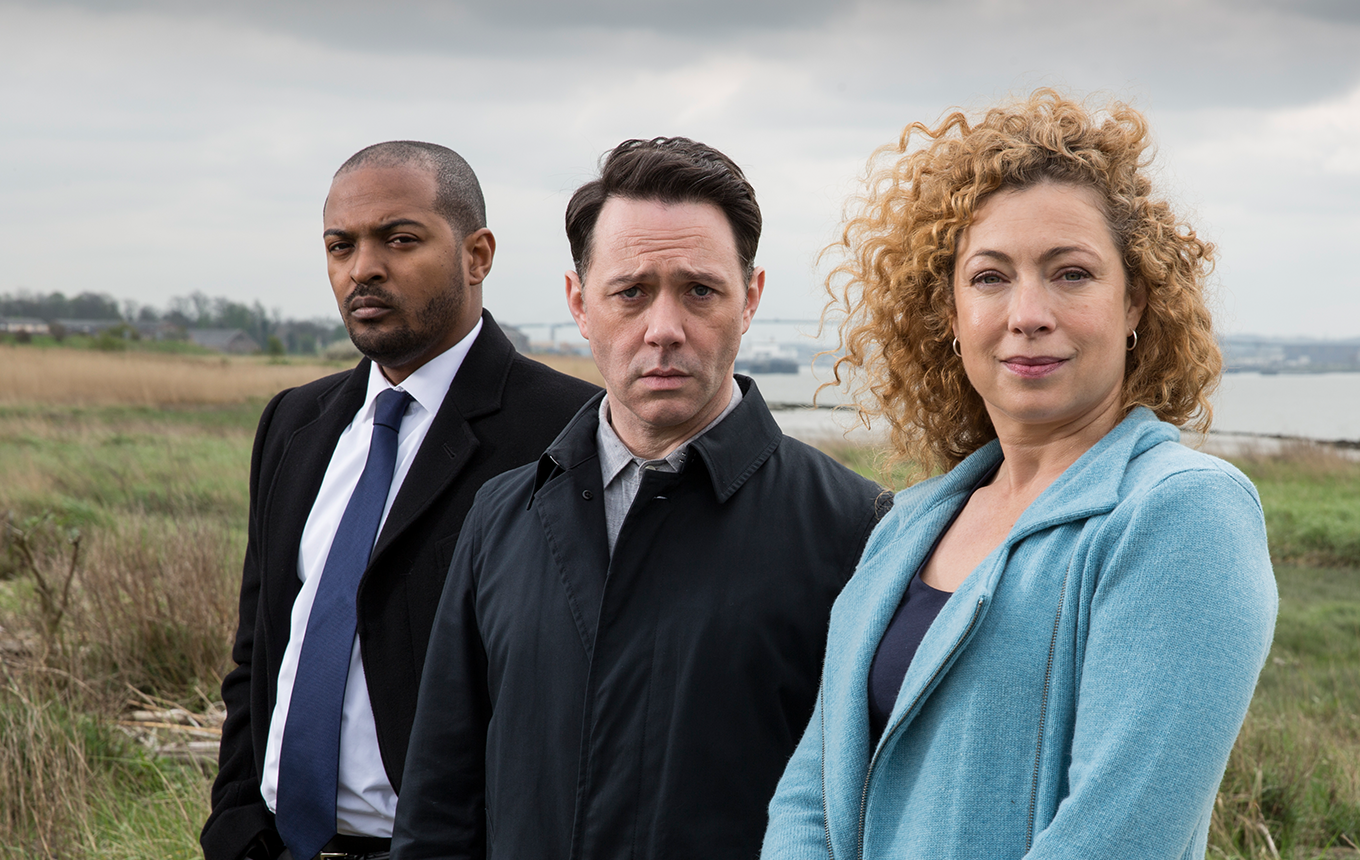
Room for another ITV crime drama? There have been allusions to 'The Bridge' because of the main cop's presence on the autism spectrum. It's clearly the 'tick du jour', and who better to play it than Reece Shearsmith, fresh from his wife-killing psycho in another ITV crime drama. "Does she have bad breath?" he bluntly asks the anxious parents of a missing girl. They clearly see DS Sean Stone, demoted to the missing persons unit, as a Holmesian character whose quirks aid his razor-sharp mind etc. Alex Kingston is his warm-hearted, divorced mother foil, Ruth Hattersley and Noel Clarke his uppity young boss DCI Prior.
His first case is investigating girls who have gone missing after visiting a website for suicidal people - no, not the Samaritans. And that's about it for feasible plot so far. The rest is fill: Hattersley has a weird son and Stone a helpful cleaner; or unlikely jokes at the expense of Stone's autistic tendencies and the usual cop TWNHs. You might be forgiven for thinking policemen aren't the most articulate on the planet, but it's hard to believe that Stone negotiated his way to Sergeant with his lack of tact, or that Hattersley would be daft enough to agree to meet the suspect, whom she's only approached online, alone in what looks like an abandoned shopping centre.
It's ok, but a slightly queasy mix of serious story and odd humour, and will really have to up the ante to sustain four episodes (though so riddled with ad breaks that each can't be more than 45 minutes at most).
Sunday, 31 August 2014
Crimes of Passion

With the Brits busy imitating Skandi Noir (Hinterland, Broadchurch) here comes a Swedish crime drama owing far less to its countrymates like 'The Killing' and 'Wallender' than to quintessential Brit crime queen Agatha Christie. There's even a sly reference by a character to 'Ten Little Indians' and the setting - an island where the guests at a Midsummer's Eve party in the 1950s are murdered one by one - is a definite homage.
'Crimes of Passion' is a new six-parter on BBC4's foreign crime slot on a Saturday evening, based on the 1940s/50s books by Maria Lang. Our main character, Puck (Tuva Novotny) keeps a beady eye on the investigation like a young Miss Marple, attracting attention from the womanizing policeman Wijk (Ola Rapace) as well as her true love Einar (Linus Wahlgren). All the usuals are here: an isolated, would-be idyllic setting and a cast of characters mired in various delusions and tortured relationships, plus the tongue-in-cheek knowingness that the most recent batch of Marples and Poirots all display. The period setting adds glamour, of-course; no kitchen-sink grime to be seen, and what current drama is complete without a 21st Century preoccupation at the heart of the matter?
Nothing new, then, but good cosyish fun for a quiet evening in.
Friday, 8 August 2014
Walter

Our eponymous hero is an amiable, bumbling cop with a sweet, posh daughter. No prizes for guessing this isn't gritty drama along the lines of 'Line of Duty', which confusingly also featured Adrian Dunbar as a financially compromised detective. That's the only similarity. The opening scene may feature a worried-looking man going under a tube train, but this is a comedy-drama. It's not a hybrid we've ever warmed to, because to carry it off requires first class writing which, in the days of marketing, ratings and pressured deadlines, is pretty rare.
Dunbar is a good enough actor to play hero, jester or villain and carry an audience with him all the way, and Alexandra Roach is likeable as his ditzy, sassy sidekick, but OMG they deserve a better script. This involves a corrupt cop with a late-blooming conscience (like we said, not realism), and a murder which almost foxes the police, thanks to their undercover officer going awol. It's sort of in the same spirit as 'New Tricks' - there are jokey scenes with the young, gay Chief Super, widower dad Walter and lovelorn Anne with her Welsh mother - but it needs a more even tone and tighter plotlines if it's going to spin out to a series. There's potential for a nice light drama with a few laughs, maybe in a Sunday evening 8pm slot, but in the tough world of today's TV they may already have blown their one chance by an underwritten pilot, shown on a Friday evening in August.
Sunday, 6 July 2014
Common

Jimmy McGovern thinks the legal concept of joint enterprise is a bad thing, and he's written a one-off drama to show us why. It has always been something of a controversial matter, as in the case of Derek Bentley, who was hanged for his allegedly saying "Let him have it" to his younger companion, even while he didn't pull the trigger, had learning difficulties, and was arguably urging Christopher Craig to hand over the gun, rather than use it. Craig, of-course, was too young to hang.
So here we have Johnjo O'Shea (Nico Mirallegro from 'The Village') giving some friends a lift to get a pizza in his brother's car and becoming a horrified getaway driver when they end up claiming a victim instead of a Margherita. Viewing the lads as a gang, the police want prosecutions under joint enterprise, which means that Johnjo's not being at the murder scene and claiming his innocence of any intent is not a good enough defence. His parents and those of the victim - a bystander - both want what they perceive as justice for their sons.
This is familiar McGovern territory - the solid working class under threat - and his reputation gets him the airtime to explore the aftermath of this single act of violence for the estranged, bereaved Wards (Susan Lynch and Daniel Mays) and for the bewildered O'Sheas (Jodhi May and Andrew Tiernan). Arguably, McGovern doesn't need 90 minutes. A wail of anguish and a throwaway remark are the kind of moments that nail the realities of life for the families in his dramas, and with this calibre of cast it's enough. Johnjo, like many of the accused in joint enterprise cases, finds himself between a rock and a hard place: get tried for murder and face a potential life sentence, or plead guilty to conspiracy to commit GBH and face a probable 6 years. His fellow accused manage to persuade the one who actually stabbed the lad to plead guilty to murder, but must then rely on Johnjo to plead guilty to the lesser charge alongside them, or all of them will stand trial for murder. So despite being genuinely innocent, even of the plan to assault a local lout that the pizza parlour manager was party to, Johnjo faces imprisonment. His lawyer and his aunt urge him to take the lesser charge, believing that the establishment use joint enterprise "to clear the scum off the streets", while his mother objects on moral grounds (and presumably the rather more prosaic ones that he will emerge with a criminal record). For Johnjo, a haemophiliac, neither option is desirable.
It's decent drama exploring a deserving subject - apparently a select committee is currently looking into the law that has its basis in preventing duelling in the 18th Century - but weighted here by our knowledge of the fact that Johnjo did not break any law. For the judge and, had it gone to full trial, the jury, there would be circumstantial evidence in the form of CCTV footage of the car, engine running, outside the pizza parlour and the lads running over to it before driving swiftly away, though the lads claim they would have backed up his plea of ignorance as to their intent. In other cases, such as those where someone in his position is guilty of involvement in a conspiracy to murder or cause GBH, then might there be some positives to this charge? We hope the select committee will look carefully at the issue, but it'll take more than that to stop random violence among young men, or prejudice on the part of prosecutors.
McGovern's next project, due to air next year, is 'Banished', set in an 18th Century Australian penal colony and concerning the lives and loves of prisoners. So, no topical arguments then? Doubtless our Jimmy will find a way to reflect our own crumbling prison system, with a bit of Brookside-in-bodices thrown in.
Wednesday, 25 June 2014
Murdered by my Boyfriend

A 'does what it says on the tin' title that nonetheless doesn't do justice to this hour-long drama based on a real case. We have nothing against BBC3, but don't often watch it, and this was a worthwhile exception. 17-year-old Ashley (Georgina Campbell) meets Reece (Royce Pierreson) at a party. They have friends in common and even went to the same school, and their obvious mutual attraction soon blossoms into a relationship that has Ashley telling friends she's happy and in love. Reece, however, has a possessive streak and strange ideas about domestic harmony, and things turn sour when Ashley discovers she is pregnant. He promises her the earth to keep their baby, but refuses to live with her and is unfaithful. His short fuse has him lashing out, in front of their daughter, and his physical strength and manipulative talk inflicts real damage on her bodily and mental health.
The spoiler is in the title, but what makes this worth watching are the nuanced performances from the leads (and nice to see Kate Hardie on screen again). They are good enough to make you understand what is often incomprehensible: why would anyone stay with a violent partner? Ashley is young, impressionable and in love, wanting a father for her daughter, and drained of her natural confidence by her intimidating boyfriend. He has a predator's instinct for undermining her, and literally and metaphorically battering her into submission to his will.
A brave drama. The news may feature celebrity-led protest against gender-based atrocities abroad, but domestic violence on our doorstep is on the rise too.
Subscribe to:
Posts (Atom)