"That Would Never Happen!" Dan and Ali write the real reviews of UK TV drama serials (stuff marketed as quality, if you please), telling it like it is rather than the my-mate's-the-director, I-get-party-invites, or the I-need-my-job reviews that often appear. Not to mention the I've-not-watched-it....
Showing posts with label Christopher Eccleston. Show all posts
Wednesday, 23 March 2016
The A Word
Joe is five, and spends most of his time belting out his dad's favourite music while listening to the songs on his headphones. He doesn't get invited to his classmates' parties. His mum and dad reluctantly consult doctors as to whether their son is somewhere on the spectrum of the 'A' word.
We seem to recall a similarly-themed one-off drama on ITV a few years ago with Keeley Hawes and Ben Miles as worried parents of a young boy. As there, the wider family get involved (the boy's brewer uncle and his adulterous doctor wife, the un-pc granddad played by a surely-too-young Christopher Eccleston) and there's clearly a rocky road ahead. It's watchable, has great performances and beautiful Cumbrian scenery, but at the moment it feels a little by-numbers and predictable. It's true we've been spoiled with the likes of the second series of 'Happy Valley' - better than the first - and the upcoming third series of 'Line of Duty', but we're not yet sure what this will have to offer to offer above and beyond another exploration of autism.
Labels:
A Word,
autism,
BBC,
Christopher Eccleston,
Drama,
Lee Ingleby,
Morven Christie,
TV,
UK
Tuesday, 21 April 2015
Safe House
"It's okay, they're saying we might be the new 'Broadchurch'."
The clue is in the title, since the drama would be a pretty poor one if the house was actually safe. Robert (Christopher Eccleston) is an ex-cop who had a breakdown after a woman he was protecting was shot in the street. He has renounced policing and has restored a remote, grim old house with his wife (Marsha Thomason) and has made a new life for himself running a B&B, acquiring enough friends to make a decent birthday party and swimming in the lake without a thought of Weil's disease. When his wife invites his ex-colleague (Paterson Joseph) to visit their idyll, Robert is persuaded to allow his house to be used as a 'safe house', protecting vulnerable witnesses. (This might not seem like a good idea, but characters in dramas are not to be dissuaded, and Robert does at least show a nifty line in evading a pursuer in a car chase.)
A mum (Nicola Stephenson), her young son and teenaged stepdaughter arrive at the house after the boy was the victim of an attempted kidnapping which hospitalised his father (Jason Merrells). Blackpool Pleasure Beach seems a rather odd choice for an abduction, and either the child mysteriously didn't scream or the crowds just ignored a child in peril as the bearded villain made off with him. It's clear the man knew the dad, who came after him and was getting a kicking when a motorist, presumably an innocent bystander, waded in to help and was subsequently stabbed. Recovering in hospital, dad is stunned to hear that the stabbed victim has died and shockingly reluctant to accept help from the police. Could this have something to do with his student son, who is AWOL and clearly involved in something dodgy?
This is one of those dramas that ratchets up the tension consistently and throws in just enough backstory to keep things interesting, the risk being that the pay off has to be pretty strong to make it all worthwhile. No wishy-washy, or wildly unlikely, explanations for the action are going to satisfy viewers who have given four episodes of their time (time may as well be measured in episodes as in minutes, or coffee spoons). We are rooting for it, having sat through one, and if it must be compared to 'Broadchurch', please let it be series one and not series two.
Labels:
Christopher Eccleston,
Crime,
Drama,
ITV,
Jason Merrells,
Marsha Thomason,
Nicola Stephenson,
Paterson Joseph,
review,
Safe House,
Sarah Smart,
TV,
UK
Tuesday, 3 February 2015
Fortitude
Fortitude is Sky's new big-budget drama - reportedly costing £30m for 12 episodes, broadcast here on Sky Atlantic, in the US on cable network Pivot, and pre-sold to a number of other broadcasters around the world.
We should start with the business side of the programme, because it's clearly a business-driven enterprise - an attempt to make an internationally appealing show that will generate revenue and become a 'franchise' or more accurately, a licence to print money.
The different elements are there - an international cast of well-respected actors (Brits, Nordics, Americans), internationally known stars from previous big hits (Sophie Gråbøl from 'The Killing', Christopher Eccleston from 'Doctor who', Michael Gambon from the 'Harry Potter' films, Stanley Tucci from 'The Hunger Games'), a beautiful and unusual setting - the Arctic - and a script that promises lots of twists and turns, not to mention red herrings.
Fortitude is the name of a small town in the Arctic Circle, and serves as the setting for the show. Based on Svalbard, a town with a population of 2,000 people, Fortitude itself has just 700 people, and as the Mayor, played by Sophie Gråbøl, explains, everyone who is there has a job, so there is no crime. Characters range from policemen, photographers, doctors, plus what looks like some miners or similarly industrial workers. Oh - and there's a bar full of hairy heavy metal fans with unspecified jobs, and there seem to be just two children that we've seen so far (and presumably a school teacher?).
Given that you have this community of interdependent people in a hostile environment, what it resembles a bit is a space drama. Who is killing members of the crew? Is it a monster out in the wild, or is it the enemy within?
The first episode moved along well though, and we will continue watching. Whether it justifies the big investment from a financial point of view remains to be seen; the last show Sky heralded quite as enthusiastically as this was The Tunnel, and that never made it to a second series.
Thursday, 12 December 2013
Lucan
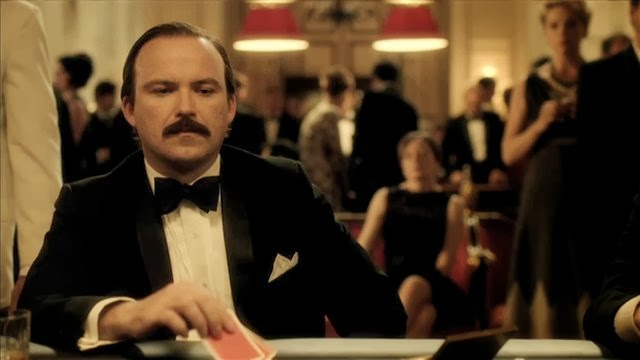
Lucky Lord Lucan won over £20,000 in one night at the tables in Le Touquet, in the days when you could easily buy a couple of 3-bed semis for that sum. Had he also been Logical Lord Lucan he would have walked away and never entered any place of gambling again. He was, however, a gambling addict, a bored husband and, by Jeff Pope's account (based on John Pearson's book 'The Gamblers') a bit of a waste of space. In short, if you think the British aristocracy are, or even were, a bunch of loveable eccentrics, or bores a la 'Downton Abbey', then you won't enjoy ITV's dramatization of this case, arguably of Britain's most famous missing criminal.
John Bingham, Earl Lucan (Rory Kinnear, superb) is a deeply unhappy 'professional gambler' who spends his time at the tables of John Aspinall's Clermont Club in Berkeley Square. To most of us under 50, Aspinall is synonymous with zoo-keeping, which is ironic considering his belief in animal instincts and his wilful interpretation of Darwinian theory. Here played by a cast-against-type Christopher Eccleston, his chief assets in life are his easy-seeming charm and his hosting abilities, which he uses to lure the scion of England's landed families into gambling away their inheritances. Along with his waning wealth, Lucan is tired of his marriage to Veronica (Catherine McCormack, whom we don't see enough of these days) but determined not to lose custody of his children. Unfortunately for him, he confides in Aspers, who advises using any means necessary to get what he wants. When Lucan's original plan to accuse his wife of insanity backfires, his pathetic self-pity turns to anger for which the children's nanny, Sandra Rivett (Leanne Best) will ultimately pay.
Lady Lucan and the children are very much alive (and unsurprisingly did not collaborate in the making of the drama) but Lucan's disappearance after that November night in 1974 has made him into an enigma. Unproven sightings are many and varied, as are claims that he is definitely dead, and next week's conclusion to this re-telling may not convince us either way, but this is a very watchable, well-cast and acted production. It's a shame that the subject matter leaves a sour taste in the mouth. No doubt the idea wasn't to glamorise people who were only extraordinary for their (largely unearned) wealth and possibly their viciousness, but there's no satisfaction in realising that who and not what you know is still the way things work, and that there is still a sense of entitlement from those at the top, with a widening gap between them and those at the bottom.
Labels:
Catherine McCormack,
Christopher Eccleston,
Drama,
Gemma Jones,
ITV,
Jane Lapotaire,
Lucan,
Michael Gambon,
review,
Rory Kinnear,
UK
Thursday, 5 July 2012
Blackout - spoilers
In the first of a three-part drama, Daniel Demoys (Christopher Eccleston) is an alcoholic, sex-addicted councillor of an unnamed city where it's always raining. City Hall is some vast monolithic nightmare. His daughter dances at a school performance with smudge-dark eyes and they live in a house that even Dracula might want to brighten up a bit. You'd be forgiven for thinking this was Gotham City and that Eccleston might be wavering between donning a bat mask or a too-large painted grin.
He meets a businessman in a dark alley, at night, in the eternal rain, and it's obvious he's bent as the proverbial nine-bob. They argue, there's violence. Cut to Daniel waking up to find out his wife has reached the end of her patience, his kids are frightened of him and the businessman he fought with is comatose in a hospital. He goes to his estranged sisters, who happens to be a solicitor, for help. She's a crusader, but even she doesn't want to know what her brother's been up to. Until, that is, he takes a bullet for a young black man who's her client, and a witness in a controversial trial. She enlists a political fixer who pushes Daniel to stand for the mayoral elections. Daniel says no, no again, then yes, warning his potential voters that he's a bad boy. As if to prove it, the comatose businessman dies, leaving a daughter who thinks Daniel is a hero for his very public act of good. The loose thread who could undo him, however, is really the prostitute he'd had in the back of a downmarket bar, who witnessed the fight with the businessman and was caught on cctv running away. She has an ex still obsessed with her who has a career as... you've guessed it, a cop.
Could turn out to be wonderful, but probably won't. (What's the betting that the prostitute gets killed and it could be Daniel or the ex?) Nonetheless, we'll be tuning in for the second episode, for the performances if nothing else. Olivia Cooke as Daniel's teenaged daughter is particularly affecting. It's just a shame that they have to make a fairly TWNH storyline even less believable by having Daniel recover from a serious shooting in no time flat, to the point where he's wandering around the hospital - in ITU of all places - lying on his injured side and allowing his wife to lean on his injured shoulder. Maybe he is a superhero/supervillain after all.
Labels:
andrew scott,
BBC1,
Branka Katic,
Christopher Eccleston,
Dervla Kirwan,
Ewan Bremner,
lyndsey marshal,
MyAnna Buring,
review,
TV,
UK
Tuesday, 7 June 2011
The Shadow Line reminds me of...
It's time for another post on The Shadow Line. As the series has progressed a few things have become clear:
- It's too long, and has too many characters. It would have been better as a shorter, less convoluted story.
- It's hard to follow, and it seems to take pride in this.
- There are still lots of TWNHs - for example a shop is turned into a fireball, and the two men inside walk away. Hmmm
- It's not as good as Psychoville 2, also showing on BBC 2.
Psychoville 2 is also a story with lots of characters. There's a mysterious man who goes around killing off the main characters. There's a woman who has a terminal illness, and her companion (her son in this case) is very upset by this. There are some mysterious powers at work. There are some gruesome killings (Oscar Lomax's hanging, for example) There is a shop that isn't what it seems (Hoyti Toyti, which turns out to have a cellar full of Nazi artifacts). However Psychoville manages to hold it together much more successfully, and isn't nearly as confusing.
I think maybe someone at the BBC was laughing to themselves when they they scheduled Psychoville 2 straight after The Shadow Line!
Labels:
Anthony Sher,
Chiwetel Ejiofor,
Christopher Eccleston,
Comedy,
Drama,
Hugo Blick,
Lesley Sharp,
Reece Shearsmith,
review,
Shadow Line,
Stephen Rea,
Steve Pemberton
Friday, 13 May 2011
The Shadow Line
Unfair to review before reaching the end, so this is a work in progress.
Generally speaking, we have no problem with slow. If you tune into a thriller, it can hit its ground running or take all the time it needs to ratchet up the tension. It’s when it takes more time than it needs, and way more time than it should, that there’s a problem. Even the pre-credit sequence of the first episode was too darned long, to the point of being boring, and by the end of that episode our impressions were that ‘Shadow Line’ loved itself, deeply and solemnly, and at the expense of anything like a convincing performance from the usually-good Rafe Spall. It tried its best to confuse, but as the closing credits appeared, you knew you were dealing with a quarrelling criminal gang, complete with psycho scion (the aforementioned Spall, the victim’s nephew) and a cop with a past that he (in)conveniently can’t remember. We’ve been here before, just a few times.
13th May. Episode two has a tense chase at the end. Nothing like it for obliterating the dull 50 minutes building up to it. For us, it wasn’t quite that good, partly because every ten seconds it looked like Andy, our AWOL driver, had to get caught by one of the people chasing him, and then suddenly there he was again, way out in front, with not a tree root or heart attack to beleaguer his pursuers. The other reason is that, like extreme pain, the sheer self-indulgence of the various interview/interrogation scenes preceding it was hard to forget. And lest we neglect them, the intimidated partner and mother of our AWOL driver, knowing at least something about what he’d been involved in, cheerily open the door to two strange men, one after the other. TWNH. Oh and the seriously sinister drug baron/criminal overlord who is owed money by the gang says he has been waiting for it for two years. Most patient drug baron/criminal overlord ever? Lucky gang! He also agrees to Bede’s so-surefire-it’s-never-been-done-before plan after 5 minutes. Lucky, lucky gang!
20th May. Episode Three was an improvement. Rafe stopped chewing the carpet (only so much twist'n'pile an actor can take?) and there was less of the staged set-piece feel of the previous hours. We are prepared to follow in the increasing hope that there is a decent payoff at the end of the series.
That said, trained cop Gabriel wipes his bloody paws on the crime scene. Presumably this will have repercussions for him later, but it was a pretty clumsy device. And Harvey, lately a crime lord, has but one mourner at his funeral - mad Rafe. The cops were so excited when mourner # 2 turned up they took endless pictures. They'd obviously been hoping for a Krays-style underworld bash. Even his 'lieutenant' (do they all watch 'The Wire' in the way that mobsters watch 'The Godfather'?) failed to show up. Is it an offence? The two main twists revealed were intriguing, except that the Gatehouse one threw up a nice TWNH: since our AWOL driver knew he had in fact killed his boss, and the killer knew he knew, would he choose to trust this man over the boss's family and the cops?
And please, Mr Blick, give the wives something to do other than attract sympathy for their husbands!
27th May. We have a division. Dan likes it more than Ali. As divisions go, this is not unusual and not serious.
What Ali dislikes is that, more than halfway through the series, the main characters are all people she’d take serious detours to avoid, be they criminals, cops or journalists. This isn’t only because they are inherently unsympathetic, but because they all speak as though they were in an o.t.t. send-up of a noir thriller. “It’s so much p*ss in the wind,” snarls a top cop, “and I’m beginning to feel the spray”.
Dan says he takes Ali’s points (except the pompous dialogue, which he hadn’t noticed and now can’t remember) but he still likes it, despite the TWNH (or at least the TWBUTH - Unlikely To Happen) ending. Do young, ambitious London journos live deep in the countryside? It felt like a scenic way of killing him, and also an unreliable one. The professional killer chose a method which might injure him too and not kill the target. That's if he managed to time the thing so that they'd both be on the same stretch of empty road at the same time. Note to self....
3rd June. I (Ali) must be a masochist. I can’t stop watching even though it frustrates me. Somewhere in here is, just possibly, a really good story, but it’s drained of all life by the ponderous dialogue, lovingly-framed shots and over-emotive music. It takes itself so seriously I want to laugh, and I’m feeling more manipulated than ever.
Last week’s episode ended with a splattered journalist. He wasn’t very nice, but doesn’t anyone wonder how he died? The police were preoccupied with snapping at each other about a dead colleague and how to cover their tracks. This week’s episode ended with a splattered gangster. He wasn’t very nice either, but will the police take note? The killing scene was spliced with those of other characters staring moodily, while an ironically crooning song played. A little homage to ‘Sopranos’/’Mad Men’? Sadly the likes of ‘Casualty’ got there first – and I’m deliberately ignoring Mr Coppola here.
In-between, we had this week’s big TWNH: an explosion where a shop was blown to bits but the two men inside it survived with minor cuts and bruises. Having been about to kill each other, they growl a bit and part ways. Then there was not so much a TWNH as an OHoT (Only Happens on TV) moment, with Bede starting an affair with Glickman’s girlfriend as soon as they meet. Lonely criminal meets scared gangster’s moll = obvious affair, on TV. Will there be a point to this? Will one of them end up splattered at the end of episode 6?
I’m grateful he’s trying, really I am, and hands up I’ve no direct experience, but do CEOs of drug networks really stride around in sinister hats, commit their own murders and operate state-of-the-art surveillance equipment? Are they all called things like ‘Glickman’, ‘Bede’ and ‘Gatehouse’? (I know the average cop is not called ‘Gabriel’ or ‘Honey’) And why is there always an androgynous juvenile sleeping with a seedy middle-aged gangster?
10th June. Praise be, not one but two female characters who actually had something to do in last night’s episode. One of them was Petra, who committed murder (and attempted murder), true, but hey it beats the boring old ‘love interest’ role. The other was Gabriel’s ex-mistress, whose grief helped her find some compassion, which hasn’t been very much on display anywhere in the programme so far.
Special mention for Nicholas Jones, a lovely actor who gets to spend all his time coiling ropes on docksides when not growling at unwanted visitors.
Things are now playing nicely like a Jacobean tragedy, except that the revenge motive isn’t clear. Gripping, if even less rooted in the world as anyone knows it. And no, police didn’t seem that interested in last week’s end-of-episode death either. This week they’ve got Glickman, Petra and Gabriel’s illegitimate child, so they’ll have a grand job ignoring all three, plus Gatehouse’s near-miss. We watch with interest to see if Gabriel finally gets the picture before the bullet kills him.
17th June. All over in overblown style. We think it would have been better if it hadn't screamed in every possible way - dialogue, acting, visuals, music - that it was so very serious, and important, and tragic. Both Rafe Spall and Freddie Fox appeared in this week's 'Miss Marple' and managed to give more convincing performances in (what should be) a campier show. Yes, we felt for Gabriel, the once-possibly-bad-but-now-struggling-to-be-good cop, as he realised that even Honey had lied to him and worked for Gatehouse. We even felt for Bede, for whom letting go of his suicidal wife meant letting go of his own life. But...
Are we meant to believe in major drug operations being masterminded by bent cops for decades? Masterminded by one department, being investigated by another, some of whom are also, shall we say, walking the Shadow Line? Somehow the suicide of our skipper friend the ex-Commander didn't ring true either: he'd given a helpful run-down of events to Gabriel, justifying everything he'd done (it was all for our pensions, don't you know), and surely if Gatehouse had wanted him dead, he'd have been splattered all over his deck long ago, so why kill himself? And what became of the customs guy Beatty and the cop Foley, last seen as Beatty's punch bag? The scene had one of the series' few moments of intentional humour when they both stopped the violence to flash their ID cards at a passing patrol car. Even the familiar upbeat ending of a birth was clouded with predictions of doom by the late Gabriel's boss in a scene redolent of the drowning cat in episode two; both should have been terrifying, but ended up being a bit silly. "We always look after our own," snarls the Commander as he salutes the newborn in front of his nonplussed mother. Someone should have told him that (a) Gabriel was no longer one of theirs, even if he ever had been, (b) babies are a bit young to recruit and (c) this wasn't 'Rosemary's Baby' nor 'The Omen'.
We know this has its fans, and maybe we should thank the telly-watching gods that original dramas are made at all, but it could have been much better and it's a shame it isn't. Mostly it feels like a film student's idea of what a classy thriller should be, with the elements to include ticked off one-by-one: violent murders, warehouses, sex, ailing wives, suitcases of money, guns, bent cops, foreign dealers, at least one psycho, characters speaking cryptic lines etc. In all, it doesn't add up to much more than the sum of its borrowed parts. Does Mr Blick understand his plot? It's a kindness to say he doesn't, because otherwise he just didn't do his job in communicating it very well. Were we the only lost viewers, we would keep quiet and enrol on a course, but we seem to be two of many. Perhaps, as Foley says, the only way to get through it is to know nothing? What have we got for seven hours of our lives, other than being very wary of hatted strangers at the front door?
17th June. All over in overblown style. We think it would have been better if it hadn't screamed in every possible way - dialogue, acting, visuals, music - that it was so very serious, and important, and tragic. Both Rafe Spall and Freddie Fox appeared in this week's 'Miss Marple' and managed to give more convincing performances in (what should be) a campier show. Yes, we felt for Gabriel, the once-possibly-bad-but-now-struggling-to-be-good cop, as he realised that even Honey had lied to him and worked for Gatehouse. We even felt for Bede, for whom letting go of his suicidal wife meant letting go of his own life. But...
Are we meant to believe in major drug operations being masterminded by bent cops for decades? Masterminded by one department, being investigated by another, some of whom are also, shall we say, walking the Shadow Line? Somehow the suicide of our skipper friend the ex-Commander didn't ring true either: he'd given a helpful run-down of events to Gabriel, justifying everything he'd done (it was all for our pensions, don't you know), and surely if Gatehouse had wanted him dead, he'd have been splattered all over his deck long ago, so why kill himself? And what became of the customs guy Beatty and the cop Foley, last seen as Beatty's punch bag? The scene had one of the series' few moments of intentional humour when they both stopped the violence to flash their ID cards at a passing patrol car. Even the familiar upbeat ending of a birth was clouded with predictions of doom by the late Gabriel's boss in a scene redolent of the drowning cat in episode two; both should have been terrifying, but ended up being a bit silly. "We always look after our own," snarls the Commander as he salutes the newborn in front of his nonplussed mother. Someone should have told him that (a) Gabriel was no longer one of theirs, even if he ever had been, (b) babies are a bit young to recruit and (c) this wasn't 'Rosemary's Baby' nor 'The Omen'.
We know this has its fans, and maybe we should thank the telly-watching gods that original dramas are made at all, but it could have been much better and it's a shame it isn't. Mostly it feels like a film student's idea of what a classy thriller should be, with the elements to include ticked off one-by-one: violent murders, warehouses, sex, ailing wives, suitcases of money, guns, bent cops, foreign dealers, at least one psycho, characters speaking cryptic lines etc. In all, it doesn't add up to much more than the sum of its borrowed parts. Does Mr Blick understand his plot? It's a kindness to say he doesn't, because otherwise he just didn't do his job in communicating it very well. Were we the only lost viewers, we would keep quiet and enrol on a course, but we seem to be two of many. Perhaps, as Foley says, the only way to get through it is to know nothing? What have we got for seven hours of our lives, other than being very wary of hatted strangers at the front door?
Labels:
Anthony Sher,
Chiwetel Ejiofor,
Christopher Eccleston,
Drama,
Hugo Blick,
Lesley Sharp,
review,
Shadow Line,
Stephen Rea,
TV,
UK
Subscribe to:
Posts (Atom)