Showing posts with label Michael Gambon. Show all posts

Saturday, 5 March 2016

Churchill's Secret


'Elderly man isn't all that well' isn't really a revelation, but when the man in question is Prime Minister Winston Churchill (Michael Gambon), symbol of British Bull-doggedness in WWII, the news is not to be bandied about.  Loyal members of his cabinet want the PM's stroke kept under wraps, lest there's an unseemly scramble for power in the absence of both Churchill and likely successor Anthony Eden (Alex Jennings), who was having gall bladder surgery abroad.  Mrs. Churchill, the redoubtable-in-her-own-right Clementine (Lindsay Duncan), wants Winston away from the temptations of Westminster and brings him back home to the Kent countryside home of Chartwell.  To nurse him, they contract Nurse Millie Appleyard (Romola Garai) but their peace is short-lived when the in-fighting Tories - plus ca change! - and the equally quarrelsome younger Churchills flock to Winston's bedside.

One of those 'rather nice' dramas that will go down well in America, this is a bit of a curio.  The storyline runs in a similar way to 'The Madness of George III': statesman brought low, struggles of his family and the succession, slow recovery, lessons learned etc.  It's beautifully filmed, some of it at Chartwell itself, now a National Trust gem, and is directed solidly by Charles Sturridge.  Overall though, it's rather a byway in the great man's life, and not that one that really altered the course of his remaining decade or so.  The addition of a fictional character to nurse him, who of-course happens to be from a Labour family, seems an unnecessary addition to proceedings, and merely a cypher in whom Clemmie can confide about the grief of losing her young daughter Marigold some thirty years earlier.  Things only really spring to life when the children arrive and, facing their father's death, are candid about the drawbacks of growing up with parents who were almost always otherwise engaged.

Monday, 16 February 2015

The Casual Vacancy


Rather too much ham?

Having not read any of the Harry Potter books, nor watched the films, we can't say we came to this with eager anticipation.  Rowling seems to have set her sights firmly on the crime genre now with her second outing as Robert Galbraith on the shelves, but between magic and murder came 'The Casual Vacancy', an adult lit fic novel that garnered fairly mixed reviews.

Pagford is a fictional Gloucestershire village... and a metaphor for the seething, grasping, petty bourgeoisie of modern middle-England, according to Rowling.  The first hour (of three) introduced us to the spread of characters from the rich Sweetloves ("My wife does fun runs... well she knows people who do") to young hotpants-wearing Krystal Weedon (Abigail Lawrie) whose big mouth and drug-addicted mother bring her nothing but trouble.  The catalyst for the action is the death of Parish Councillor Barry Fairbrother (Rory Kinnear) who opposed the development of a town spa as "social engineering".  His titular vacancy is now being fought over by the pro and anti-spa lobbies, in a way that will have the Daily Mail frothing about BBC Leftie Dramas and turning over to watch the Good Old Days of the Raj on Channel 4, or possibly the entrepreneurial (if American) spirit of Mr. Selfridge on ITV.

Did we like it?  It had its moments, inevitably with this calibre of cast, but overall its tone was uneven and its characters so stark as to be almost cliche.  No doubt TV producers thought the book was an obvious choice for an adaptation, but the novel is a long one, with plenty of room for nuance, and 180 minutes of television is not going to bring out the best in the material.  We felt bludgeoned by the juxtaposition of soft sandstone exteriors and modern social housing, and an incessant soundtrack.  Extremes exist, of-course, in real villages and towns, so it's quite a feat that this feels so unnatural.  Maybe it's the - it has to be said - Harry Potteresque nature of everyone so far.  The Mollisons (Michael Gambon and Julia McKenzie) are shallow, devious snobs while Fairbrother, whose online identity someone is appropriating (or are they?) to comment on the ongoing Pagford squabbles, was just trying to do the right thing for the locals, and his abused nephews.   We have the comically absurd plotting of the Councillors one minute and a toddler being neglected in a drug den the next.  The problem of being not-quite drama and not-quite comedy is that the social commentary comes across as rather blatant, and black and white worlds tend to make drab grey dramas.

Tuesday, 3 February 2015

Fortitude


Fortitude is Sky's new big-budget drama - reportedly costing £30m for 12 episodes, broadcast here on Sky Atlantic, in the US on cable network Pivot, and pre-sold to a number of other broadcasters around the world.

We should start with the business side of the programme, because it's clearly a business-driven enterprise - an attempt to make an internationally appealing show that will generate revenue and become a 'franchise' or more accurately, a licence to print money.

The different elements are there - an international cast of well-respected actors (Brits, Nordics, Americans), internationally known stars from previous big hits (Sophie Gråbøl from 'The Killing', Christopher Eccleston from 'Doctor who', Michael Gambon from the 'Harry Potter' films, Stanley Tucci from 'The Hunger Games'), a beautiful and unusual setting - the Arctic - and a script that promises lots of twists and turns, not to mention red herrings.

Fortitude is the name of a small town in the Arctic Circle, and serves as the setting for the show.  Based on Svalbard, a town with a population of 2,000 people, Fortitude itself has just 700 people, and as the Mayor, played by Sophie Gråbøl, explains, everyone who is there has a job, so there is no crime.  Characters range from policemen, photographers, doctors, plus what looks like some miners or similarly industrial workers.  Oh - and there's a bar full of hairy heavy metal fans with unspecified jobs, and there seem to be just two children that we've seen so far (and presumably a school teacher?).

Given that you have this community of interdependent people in a hostile environment, what it resembles a bit is a space drama.  Who is killing members of the crew?  Is it a monster out in the wild, or is it the enemy within? 

The first episode moved along well though, and we will continue watching.  Whether it justifies the big investment from a financial point of view remains to be seen; the last show Sky heralded quite as enthusiastically as this was The Tunnel, and that never made it to a second series.

Sunday, 6 July 2014

Common


Jimmy McGovern thinks the legal concept of joint enterprise is a bad thing, and he's written a one-off drama to show us why.  It has always been something of a controversial matter, as in the case of Derek Bentley, who was hanged for his allegedly saying "Let him have it" to his younger companion, even while he didn't pull the trigger, had learning difficulties, and was arguably urging Christopher Craig to hand over the gun, rather than use it.  Craig, of-course, was too young to hang.

So here we have Johnjo O'Shea (Nico Mirallegro from 'The Village') giving some friends a lift to get a pizza in his brother's car and becoming a horrified getaway driver when they end up claiming a victim instead of a Margherita.  Viewing the lads as a gang, the police want prosecutions under joint enterprise, which means that Johnjo's not being at the murder scene and claiming his innocence of any intent is not a good enough defence.  His parents and those of the victim - a bystander - both want what they perceive as justice for their sons.

This is familiar McGovern territory - the solid working class under threat - and his reputation gets him the airtime to explore the aftermath of this single act of violence for the estranged, bereaved Wards (Susan Lynch and Daniel Mays) and for the bewildered O'Sheas (Jodhi May and Andrew Tiernan).  Arguably, McGovern doesn't need 90 minutes.  A wail of anguish and a throwaway remark are the kind of moments that nail the realities of life for the families in his dramas, and with this calibre of cast it's enough.  Johnjo, like many of the accused in joint enterprise cases, finds himself between a rock and a hard place: get tried for murder and face a potential life sentence, or plead guilty to conspiracy to commit GBH and face a probable 6 years.  His fellow accused manage to persuade the one who actually stabbed the lad to plead guilty to murder, but must then rely on Johnjo to plead guilty to the lesser charge alongside them, or all of them will stand trial for murder.  So despite being genuinely innocent, even of the plan to assault a local lout that the pizza parlour manager was party to, Johnjo faces imprisonment.  His lawyer and his aunt urge him to take the lesser charge, believing that the establishment use joint enterprise "to clear the scum off the streets", while his mother objects on moral grounds (and presumably the rather more prosaic ones that he will emerge with a criminal record).  For Johnjo, a haemophiliac, neither option is desirable.

It's decent drama exploring a deserving subject - apparently a select committee is currently looking into the law that has its basis in preventing duelling in the 18th Century - but weighted here by our knowledge of the fact that Johnjo did not break any law.  For the judge and, had it gone to full trial, the jury, there would be circumstantial evidence in the form of CCTV footage of the car, engine running, outside the pizza parlour and the lads running over to it before driving swiftly away, though the lads claim they would have backed up his plea of ignorance as to their intent.  In other cases, such as those where someone in his position is guilty of involvement in a conspiracy to murder or cause GBH, then might there be some positives to this charge?  We hope the select committee will look carefully at the issue, but it'll take more than that to stop random violence among young men, or prejudice on the part of prosecutors.


McGovern's next project, due to air next year, is 'Banished', set in an 18th Century Australian penal colony and concerning the lives and loves of prisoners.  So, no topical arguments then?  Doubtless our Jimmy will find a way to reflect our own crumbling prison system, with a bit of Brookside-in-bodices thrown in.

Thursday, 12 December 2013

Lucan


Lucky Lord Lucan won over £20,000 in one night at the tables in Le Touquet, in the days when you could easily buy a couple of 3-bed semis for that sum.  Had he also been Logical Lord Lucan he would have walked away and never entered any place of gambling again.  He was, however, a gambling addict, a bored husband and, by Jeff Pope's account (based on John Pearson's book 'The Gamblers') a bit of a waste of space.  In short, if you think the British aristocracy are, or even were, a bunch of loveable eccentrics, or bores a la 'Downton Abbey', then you won't enjoy ITV's dramatization of this case, arguably of Britain's most famous missing criminal.

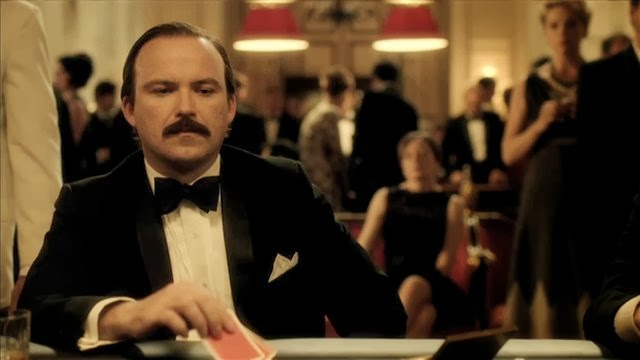
John Bingham, Earl Lucan (Rory Kinnear, superb) is a deeply unhappy 'professional gambler' who spends his time at the tables of John Aspinall's Clermont Club in Berkeley Square.  To most of us under 50, Aspinall is synonymous with zoo-keeping, which is ironic considering his belief in animal instincts and his wilful interpretation of Darwinian theory.  Here played by a cast-against-type Christopher Eccleston, his chief assets in life are his easy-seeming charm and his hosting abilities, which he uses to lure the scion of England's landed families into gambling away their inheritances.  Along with his waning wealth, Lucan is tired of his marriage to Veronica (Catherine McCormack, whom we don't see enough of these days) but determined not to lose custody of his children.  Unfortunately for him, he confides in Aspers, who advises using any means necessary to get what he wants.  When Lucan's original plan to accuse his wife of insanity backfires, his pathetic self-pity turns to anger for which the children's nanny, Sandra Rivett (Leanne Best) will ultimately pay.

Lady Lucan and the children are very much alive (and unsurprisingly did not collaborate in the making of the drama) but Lucan's disappearance after that November night in 1974 has made him into an enigma.  Unproven sightings are many and varied, as are claims that he is definitely dead, and next week's conclusion to this re-telling may not convince us either way, but this is a very watchable, well-cast and acted production.  It's a shame that the subject matter leaves a sour taste in the mouth.  No doubt the idea wasn't to glamorise people who were only extraordinary for their (largely unearned) wealth and possibly their viciousness, but there's no satisfaction in realising that who and not what you know is still the way things work, and that there is still a sense of entitlement from those at the top, with a widening gap between them and those at the bottom.