Showing posts with label Rory Kinnear. Show all posts

Monday, 16 February 2015

The Casual Vacancy


Rather too much ham?

Having not read any of the Harry Potter books, nor watched the films, we can't say we came to this with eager anticipation.  Rowling seems to have set her sights firmly on the crime genre now with her second outing as Robert Galbraith on the shelves, but between magic and murder came 'The Casual Vacancy', an adult lit fic novel that garnered fairly mixed reviews.

Pagford is a fictional Gloucestershire village... and a metaphor for the seething, grasping, petty bourgeoisie of modern middle-England, according to Rowling.  The first hour (of three) introduced us to the spread of characters from the rich Sweetloves ("My wife does fun runs... well she knows people who do") to young hotpants-wearing Krystal Weedon (Abigail Lawrie) whose big mouth and drug-addicted mother bring her nothing but trouble.  The catalyst for the action is the death of Parish Councillor Barry Fairbrother (Rory Kinnear) who opposed the development of a town spa as "social engineering".  His titular vacancy is now being fought over by the pro and anti-spa lobbies, in a way that will have the Daily Mail frothing about BBC Leftie Dramas and turning over to watch the Good Old Days of the Raj on Channel 4, or possibly the entrepreneurial (if American) spirit of Mr. Selfridge on ITV.

Did we like it?  It had its moments, inevitably with this calibre of cast, but overall its tone was uneven and its characters so stark as to be almost cliche.  No doubt TV producers thought the book was an obvious choice for an adaptation, but the novel is a long one, with plenty of room for nuance, and 180 minutes of television is not going to bring out the best in the material.  We felt bludgeoned by the juxtaposition of soft sandstone exteriors and modern social housing, and an incessant soundtrack.  Extremes exist, of-course, in real villages and towns, so it's quite a feat that this feels so unnatural.  Maybe it's the - it has to be said - Harry Potteresque nature of everyone so far.  The Mollisons (Michael Gambon and Julia McKenzie) are shallow, devious snobs while Fairbrother, whose online identity someone is appropriating (or are they?) to comment on the ongoing Pagford squabbles, was just trying to do the right thing for the locals, and his abused nephews.   We have the comically absurd plotting of the Councillors one minute and a toddler being neglected in a drug den the next.  The problem of being not-quite drama and not-quite comedy is that the social commentary comes across as rather blatant, and black and white worlds tend to make drab grey dramas.

Thursday, 12 December 2013

Lucan


Lucky Lord Lucan won over £20,000 in one night at the tables in Le Touquet, in the days when you could easily buy a couple of 3-bed semis for that sum.  Had he also been Logical Lord Lucan he would have walked away and never entered any place of gambling again.  He was, however, a gambling addict, a bored husband and, by Jeff Pope's account (based on John Pearson's book 'The Gamblers') a bit of a waste of space.  In short, if you think the British aristocracy are, or even were, a bunch of loveable eccentrics, or bores a la 'Downton Abbey', then you won't enjoy ITV's dramatization of this case, arguably of Britain's most famous missing criminal.

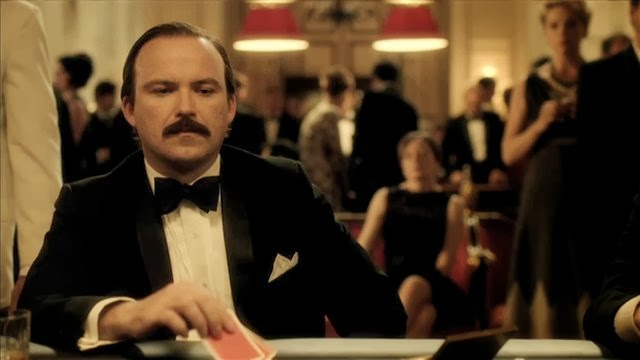
John Bingham, Earl Lucan (Rory Kinnear, superb) is a deeply unhappy 'professional gambler' who spends his time at the tables of John Aspinall's Clermont Club in Berkeley Square.  To most of us under 50, Aspinall is synonymous with zoo-keeping, which is ironic considering his belief in animal instincts and his wilful interpretation of Darwinian theory.  Here played by a cast-against-type Christopher Eccleston, his chief assets in life are his easy-seeming charm and his hosting abilities, which he uses to lure the scion of England's landed families into gambling away their inheritances.  Along with his waning wealth, Lucan is tired of his marriage to Veronica (Catherine McCormack, whom we don't see enough of these days) but determined not to lose custody of his children.  Unfortunately for him, he confides in Aspers, who advises using any means necessary to get what he wants.  When Lucan's original plan to accuse his wife of insanity backfires, his pathetic self-pity turns to anger for which the children's nanny, Sandra Rivett (Leanne Best) will ultimately pay.

Lady Lucan and the children are very much alive (and unsurprisingly did not collaborate in the making of the drama) but Lucan's disappearance after that November night in 1974 has made him into an enigma.  Unproven sightings are many and varied, as are claims that he is definitely dead, and next week's conclusion to this re-telling may not convince us either way, but this is a very watchable, well-cast and acted production.  It's a shame that the subject matter leaves a sour taste in the mouth.  No doubt the idea wasn't to glamorise people who were only extraordinary for their (largely unearned) wealth and possibly their viciousness, but there's no satisfaction in realising that who and not what you know is still the way things work, and that there is still a sense of entitlement from those at the top, with a widening gap between them and those at the bottom.

Sunday, 4 August 2013

Southcliffe

A four-parter from Channel 4 already being compared to ITV's recent 'Broadchurch', this has a reporter returning to his fictional home town of Southcliffe to investigate a rampage killing.  The first episode has focused almost entirely on Stephen (Sean Harris, who must be wary of typecasting after this and playing killer Ian Brady) in the days leading up to the gun spree.  David (Rory Kinnear) is a jaded reporter who grew up in the town and is about to return for the worst of reasons.  This doesn't break the mould in terms of the killer's profile: we so far have enough of a glimpse of his painful past and his lonely present to recognise a lost soul, and we even see a bruising encounter with recent Afghanistan-returnee Chris (Joe Dempsie) and his ex-SAS uncle which seems to prove the final straw.

Dark and tense, the only minor irritations were David's to-camera journo-speak about England's 'everytown' and the frequent ad breaks. 

Thursday, 19 July 2012

The Hollow Crown


The Extremely Light Crown would be a more fitting title.  From the way it's picked up one-handed, rolled around and generally bandied about, it must be made of sprayed aluminium.  Great for the actors, but not so wonderful for the kings, we would think, especially not Richard, whose girlish vanity undid him in the first of these Shakespearean history play adaptations.

We've seen them all before, but are not scholars of the texts, so the fact that they've been chopped up and about for the screen didn't bother us in the way it might, conceivably, to purists.  To us, they were outstanding.  The visuals were gorgeous, from lighting and costume to the choice of interior and exterior locations (though wouldn't the castles have been a bit less bare?).  Actors must have been fighting each other as fiercely as they do onscreen to be cast.  Accusations that the BBC is behind the times can be quashed here and now: yes, this is what they do best, but they have taken this seriously enough to trounce their own previous productions of these plays.  They are as freed from the stage as it's possible for Shakespeare to be, and the text rings out as clearly as the lyrical, metred lines allow.

Fabulous.

Wednesday, 11 January 2012

Edwin Drood

 
Dickens’s famously unfinished last novel gets the BBC treatment.  For those seeking comfort, his stocks-in-trade are mostly to be found: aptly-named characters, Cockney urchins and grubby old drunks, and coincidental love-interests.  Where ‘Drood’ differs from the rest is in its lack of a sympathetic central character.  The main trio of Edwin (Freddie Fox), Rosa (Tamzin Merchant) and Edwin’s Uncle John Jasper (Matthew Rhys) are all in need of a good shake, though at least Rosa comes to her senses towards the end of the first episode of two.

This made the unfolding drama less gripping than it might have been, and we can’t help but speculate as to whether Dickens would have revised and re-written swathes of it, as he often did after first serialisation.  Or maybe, in his declining years, he decided to shade his characters a little differently.  There is a lovely atmosphere of darkness, perfect for a winter evening, and as usual it all looks sumptuous but we’re not sure about the casting.  Fox is boy-band pretty with a voice to match, and does it really add anything to have the Landless twins as mixed race?  We’re not talking about colour-blind casting – their ‘foreign’ nature is a key narrative feature – but Dickens wasn’t explicit about whether they were Colonial British and seen as inferior for that reason, which was a very real prejudice of his times.  OK, it’s quibbling, and the hour rollicked along with everything pointing towards the perfect solution of Neville Landless (Sacha Dhawan) marrying Rosa, his sister Helena (Amber Rose Revah) marrying Rev. Crisparkle (Rory Kinnear), Edwin growing up a bit and Jasper suffering eternally for his impure thoughts.  Castration might be a safer solution for Rosa, but we doubt Dickens would ever have made that particular revision....

Being a 19th Century novel, however, ‘downhill’ doesn’t mean an easy ride, and we were left with a scene of Jasper apparently carrying out his laudanum-induced desires of murdering Edwin, believing him to be a rival for Rosa.  So, is Edwin really dead at Jasper’s hands?  Will Neville be blamed?  Has it left Rosa vulnerable to the unwelcome attentions of her music master?  Dickens wrote more, with his usual large cast of characters, and even hinted at an ending, but it’s been left to screenwriter Gwyneth Hughes to script her own conclusion.  It may be hard to please Dickens purists, but at least anything she comes up with won’t be any more outlandish than anything written by the great man himself. 

Tuesday, 6 December 2011

Black Mirror


If only Rory Kinnear were PM.  He has all the attributes, namely the ability to keep a straight face while saying ludicrous things.  Cameron manages too, but would he simulate sex with a pig on television if the Duchess of C were kidnapped and de-fingered?  It ought to be the acid test.

We declare an interest as Charlie Brooker fans, but his űber-spiky cynicism seems even more suited to satirical drama than to column inches.  Elegant may be a strange way to describe a story involving scoop-hungry journalists, a prurient public and an MP’s bestiality with a sow, but it was a simple premise, fitting neatly into its fifty-minute slot and brilliantly served by its cast.  We wouldn’t play poker with any of them.

Does the fact that it’s satire negate TWNH moments along the lines of mistaking a man’s finger for Suzannah’s?  Or the security forces finding no trace of her kidnapper, whose talent for art was questionable beside his flair for publicity and skill at staging a crime?  Maybe not, but if the absurd realities of modern Britain aren’t slapping you in the face already, this should shift some cogs into action.

There’s also the matter of the PM rising to the occasion when faced with a porcine rear end, but we live in an age of duck-house moats, retail riots and the Murdoch media, and we can believe anything.