"That Would Never Happen!" Dan and Ali write the real reviews of UK TV drama serials (stuff marketed as quality, if you please), telling it like it is rather than the my-mate's-the-director, I-get-party-invites, or the I-need-my-job reviews that often appear. Not to mention the I've-not-watched-it....
Saturday, 11 January 2014
Moonfleet
Apologies for the delay. Ali is still a conscientious objector to Sky, but... a fan of James Meade Faulkner's 19th Century novel and becoming rather fond of young Welsh actor Aneurin Barnard. Thus, she shamelessly asked Dan to do the honours and record it.
Since the romantic adventure novel first appeared, there has also been a 1950s film starring Stewart Granger, a 1980s Sunday teatime serial starring Adam Godley and now this 100-minute offering over two nights with Mr. Barnard as young wannabee smuggler John Trenchard and Ray Winstone as gang leader with a head and a heart, Elzevir Block. Shown over the Christmas holidays, this is solid stuff, with the first episode being largely a setup for the more exciting second. There's much to love (and no, Ali isn't referring to the underwater nude scene; honestly) in the story of the quest for a wicked forbear's hidden treasure, which retains all the staple elements of the young man's rites of passage, his filial relationship with the seasoned Elzevir and lots of derring-do.
If the romance falls a little flat it's largely because of a lack of tension. Magistrate's daughter Grace Mohune (Sophie Cookson) is rather too available and forward for an 18th Century well-born lass. They've hardly said 'hello' before they are cavorting on the beach like Burt Lancaster and Deborah Kerr in 'From Here to Eternity', so her father hardly poses a threat. All of which makes it sit just a little uncomfortably in the prime-time schedules. Is this a family drama or for adults? Its (naturally) happy ending would suggest the former, as would the somewhat rushed storytelling. For a 'good lad', why is John drawn towards violence and smuggling? Presumably in the 21st Century he'd be a drug dealer. What is he doing crawling around a graveyard at night? How does he just happen to meet Grace so often? What sort of relationship does she have with her father? Why do Dorset villagers have Cockney or Welsh accents? None of these quibbles are inexplicable, but no time is taken to develop things.
So, Sky, you beckon and beguile with your wares, but you have not tempted everyone over to the empire yet....
Labels:
Aneurin Barnard,
Ashley Pharaoh,
Drama,
Lesley Vicarage,
Lorcan Cranitch,
Phil Daniels,
Ray Winstone,
Sky,
Sophie Cookson,
TV,
UK
Monday, 6 January 2014
The 7.39
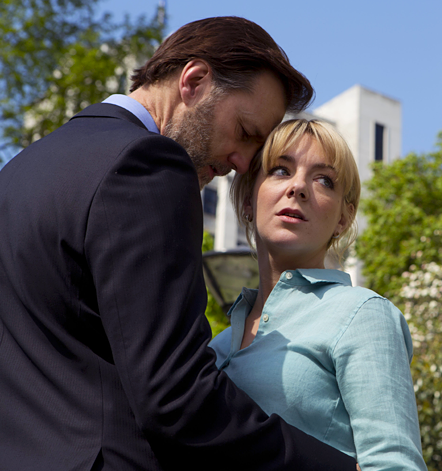
Written by 'One Day's David Nicholls, this is unsurprisingly a story of romance blossoming, in this case between two commuters. (Those with a daily commute who spend it giving thanks that they're not spliced or sharing a shower with any of the great unwashed elbowers sitting anywhere near them may find this a bit hard to swallow.)
Sally (Sheridan Smith) and Carl (David Morrissey) have comfortable lives but are mildly dissatisfied, a fact that they face when they start a friendship on the 7.39 and find themselves attracted to each other. Sally is engaged to sweet-but-gormless Ryan (Sean Maguire) while Carl is happily married to Maggie (Olivia Colman) with two teenaged children. Sally works in admin at a leisure centre while Carl has a middle-management marketing job with a boss who puts David Brent in the shade. It isn't hard to identify with both their frustrations and their guilt at their frustrations. What grates is the unlikely emptiness of the trains, streets, gym etc. and the frustratringly out-of-whack geography and yes, even trains, for anyone who knows London and commuting. Would Sally's job pay enough to justify an hour-long commute each way? Then there's an agonisingly cliched moment where they lurch into each other on a train and another where they skirt around sharing a hotel room during a train strike.
The episode ends when they are about to sleep together "just once to clear the air". Oh please. This can only end in tears, but it's hard to care whether they're the Brief Encounter tears of denial, or the tears of ruining their other relationships.
Labels:
David Morrissey,
Olivia Colman,
Sean Maguire,
Sheridan Smith
Wednesday, 1 January 2014
The Thirteenth Tale
The novel may have been a bestseller in 2006, but we'd neither of us heard of it, so we waited in vain for a haunting, or something even vaguely creepy to happen, but this was very much a cosy-slipper affair - familiar gothic/psychological thriller territory - and not much more than an ok way to spend 90 minutes of post-Christmas torpor.
Olivia Colman reprises her blunt, out of her depth role, here as biographer Margaret Lea, who visits ailing writer Vida Winter (Vanessa Redgrave with startling Titian tresses) in her country pile to hear the titular 13th tale. This turns out to involve another country pile nearby, the crumbling Angelfield, sibling incest, insanity, suicide, murder and red-haired twin girls who reminded us disturbingly of those in 'The Shining'. Perhaps the novel is more artfully constructed, but the television adaptation could have been the result of throwing du Maurier, the Brontes, Collins et al into a pot and seeing what was cooked up. Yes, it was written by Christopher Hampton, but... he remains best known for something he adapted over 25 years ago. 1950s Yorkshire, we suspect, was unlikely to be a place of total isolation for these characters for years on end. Who'd have thought that 'Heartbeat' could compare favourably in the reality stakes? Margaret has previously written a biography of the Brontes, but doesn't seem to recognise Yorkshire, unless Hampton couldn't think of a subtler way to signpost the Moors to us.
The twist in the tale is not particularly satisfying, and instead throws up more questions, like a 'Midsomer Murders' story in overdrive, and the wholly unnecessary hint of romance for Margaret with the doctor (Steven Mackintosh) at the end just brings the whole thing down to the level of chick-lit with a kink. Bit of a waste of a talented cast. Speaking of which, we're hoping Emily Beecham gets to play someone sane and Tom Goodman-Hill someone other than a faithless rotter in the near future, for their sakes.
Labels:
Alexandra Roach,
Antonia Clarke,
Diane Setterfield,
Drama,
Emily Beecham,
gothic,
Olivia Colman,
review,
Robert Pugh,
Steven Mackintosh,
Thirteenth Tale,
Tom Goodman-Hill,
TV,
UK,
Vanessa Redgrave
Thursday, 26 December 2013
Death Comes to Pemberley
Fan-fic! Don't you just love it? Well apparently about half of us do and the other half would rather re-read the originals or, heaven forfend, something entirely new. This is the adaptation of PD James's criminal spin on Jane Austen, pun intended. It seems unlikely that Baroness James woke up one morning possessed with the need to pen a crime thriller set in the fictional world of the Darcys, Bennetts et al, but stranger things happen in the world of business-driven arts these days. (We heard about an agent who requested a crime writer to 'set something in the trenches' with 2014 in mind, and when said writer suggested writing something about Dr Watson - yes, he of Holmes - almost had his arm bitten off in the agent's eagerness to snap up a likely bestseller.) 'Death Comes to Pemberley' sold well, despite a mixed reception, and was an inevitable adaptation for television, with almost as inevitable a slot at Christmas.
As a Dickens/Eliot/Bronte substitute drama, it has a cast of similar calibre and there are enough familiar pointers to reassure lovers of 'Pride and Prejudice'. It's a handsomely mounted production (though we note Elizabeth, chateleine of Pemberley, did seem to spend a lot of time in the same dress) but the murder-mystery was an odd addendum to the light but incisive wit of the original. Death also came rather slowly to Pemberley after all, it was a good half an hour before a murder was established. We'll keep watching tomorrow and Saturday, though unless the murderer is someone unknown, there aren't too many possible suspects.
So now that Death has come to Pemberley, and we've been Lost in Austen, could the time now have arrived (please!) where new adaptations of other classics, or even new writing, appear onscreen? Those who want fan fiction can find endless interpretations of endless classic stories for free on the internet, albeit of variable quality. Seeing a costly, well-written production that tweaks a familiar setting and characters is somehow like warmed-up leftovers: never as good as the original serving.
Labels:
Anna Maxwell Martin,
Death Comes to Pemberley,
Drama,
Jane Austen,
Jenna-Louise Coleman,
Matthew Goode,
Matthew Rhys,
PD James,
Rebecca Front,
Tom Ward,
TV,
UK
The Tractate Middoth
Montague Rhodes James must be one of the most terrifying men who ever lived. He looked mild enough and was a scholar at Cambridge, but depending on your inclination he would probably be the very first or very last choice to be stranded in a lonely old house with on a stormy night. Or any night. Or even any time at all. Penned over a hundred years ago, his stories still send shudders down the spine, freeze the blood and generally get under the skin. To anyone who has read or seen 'Oh Whistle and I'll Come to You, My Lad', weighing down the sheets on an unused twin bed will seem a perfectly sound act, likewise shunning a pair of binoculars unless the exact provenance is known after 'A View from a Hill'. To say Mark Gatiss is one of his keenest fans is an understatement, and lucky Mr G had the largesse of BBC2 on Christmas night to indulge his fascination.
This was lucky for us, too. We can't help thinking that a venegeful demon or two would liven up 'Downton Abbey' no end, but meanwhile, we switched over gratefully and settled down with some pud to watch 'The Tractate Middoth'. We found ourselves in familiar James territory: a dusty old library, arcane texts and men with dubious motives. As befits a Christmas tale, it was greed that proved the undoing of at least one character, John Eldred (John Castle, another actor of whom we see too little) and possibly of his successor Mrs. Simpson (Louise Jameson). James's stories always tease with ambiguity. While there are descriptive passages of what the protagonist/victim suffers, we're left wondering what exactly it is that has been unleashed on them. This clever absence of explanation leaves us unsure of how to avoid the same fate (though avoiding spiders wherever possible would seem a good start).
Gatiss is a godsend as a genuinely inventive writer who presumably enjoys writing for TV. Are others with his talent champing at the bit? We guess not, or not visibly to producers, who have at times denied us Christmas ghost stories altogether. Perhaps the only, smallest of quibbles with the adaptation was the explicit visibility of the malevolence that haunts the pages of the book to such ill effect. This was also in evidence in 'Crooked House' a few years ago, which until the flashing light sequence towards the end had proved the best Jamesian tale we had seen by another author. (Jeremy Dyson's 'The Haunted Book' has a similar seen-in-strobe effect in one story). Less is more when it comes to fear... but we're aware that it's a matter of personal taste, and that it's hard to convey visually what James manages so well in print.
At just over 30 minutes, a great little Christmas treat.
Labels:
Drama,
Eleanor Bron,
horror,
John Castle,
Louise Jameson,
Mark Gatiss,
MR James,
review,
Roy Barraclough,
Sacha Dhawan,
Tractate Middoth,
TV,
UK,
Una Stubbs
Thursday, 19 December 2013
The Great Train Robbery
There must be some correlation between a society's sophistication and its obsession with deviance and were we to look, probably a few hundred PhD theses filed away on the subject. In the wake of the recent 'Mrs. Biggs' comes 'The Great Train Robbery' about the antics of Buster, Biggs and the rest of the criminal gang in 1963. (Not to be confused with the 19th Century attempt on a train that was turned into a novel and then a rather camp film by Michael Crichton in the 1970s, nor the 1903 Western.) Not that it isn't an interesting tale, but the endless fascination induces the same queasiness as those other much-dramatised mid-20th Century cases, the Kray twins and Lord Lucan. Somehow the violence becomes a by-product.
Does this new production avoid that trap? Not entirely. For every shot of sweaty men in dingy rooms in vests, there's a scene of the all-male gang in balaclavas and bowler hats; while they may have spent much time in greasy spoons, what's depicted is a nightclub scene with the gang as erstwhile Goodfellas, and while we're on comparisons, the stylised title sequence bears an uncanny resemblance to that of the late, lamented 'The Hour,
The based-on-truth story is almost undeserving of the script and cast, with Luke Evans as gang leader Reynolds and Neil Maskell as Buster Edwards fleshing out the moral ambiguity and Jack Roth unnerving as Charlie Wilson.
"Mickey Mouse!" spits Buster at a bewildered ex-train driver who asks his name, "and the pleasure's all yours." This 90 minutes (of 180) was the criminals' tale, astonishingly aptly broadcast on the day when the real Ronnie Biggs breathed his last. It was entertainingly tense, despite the outcome being known, presumably, by the majority of the audience. There was no attempt to give the Reynolds gang hearts of gold or good intentions, but the line about not taking guns rings hollow in the wake of the train driver's fate. These were men who took pride in their criminal 'careers', prepared to use violence to get rich without honest work and, far from meticulously planning to the last detail, they left too much to chance to get away with it. In the days of DNA and other advanced forensic evidence, they'd have been lucky to get to Reigate, let alone Rio.
Maybe that's a more palatable explanation for Britain's fascination with them: from the Gunpowder Plot to the Dunkerque evacuation, it's not exactly victories we seem to love to celebrate, but near-misses.
Labels:
Chris Chibnall,
Crime,
Drama,
James Fox,
James Wilby,
Jim Broadbent,
Luke Evans,
Martin Compston,
Neil Maskell,
Nick Moran,
review,
Richard Hope,
Robert Glenister,
Ronnie Biggs,
TIm Pigott-Smith,
TV,
UK
Thursday, 12 December 2013
Lucan
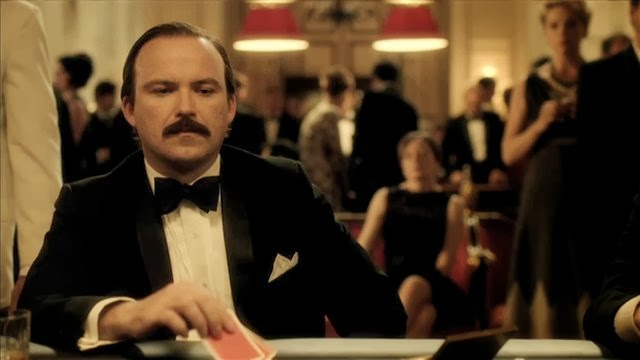
Lucky Lord Lucan won over £20,000 in one night at the tables in Le Touquet, in the days when you could easily buy a couple of 3-bed semis for that sum. Had he also been Logical Lord Lucan he would have walked away and never entered any place of gambling again. He was, however, a gambling addict, a bored husband and, by Jeff Pope's account (based on John Pearson's book 'The Gamblers') a bit of a waste of space. In short, if you think the British aristocracy are, or even were, a bunch of loveable eccentrics, or bores a la 'Downton Abbey', then you won't enjoy ITV's dramatization of this case, arguably of Britain's most famous missing criminal.
John Bingham, Earl Lucan (Rory Kinnear, superb) is a deeply unhappy 'professional gambler' who spends his time at the tables of John Aspinall's Clermont Club in Berkeley Square. To most of us under 50, Aspinall is synonymous with zoo-keeping, which is ironic considering his belief in animal instincts and his wilful interpretation of Darwinian theory. Here played by a cast-against-type Christopher Eccleston, his chief assets in life are his easy-seeming charm and his hosting abilities, which he uses to lure the scion of England's landed families into gambling away their inheritances. Along with his waning wealth, Lucan is tired of his marriage to Veronica (Catherine McCormack, whom we don't see enough of these days) but determined not to lose custody of his children. Unfortunately for him, he confides in Aspers, who advises using any means necessary to get what he wants. When Lucan's original plan to accuse his wife of insanity backfires, his pathetic self-pity turns to anger for which the children's nanny, Sandra Rivett (Leanne Best) will ultimately pay.
Lady Lucan and the children are very much alive (and unsurprisingly did not collaborate in the making of the drama) but Lucan's disappearance after that November night in 1974 has made him into an enigma. Unproven sightings are many and varied, as are claims that he is definitely dead, and next week's conclusion to this re-telling may not convince us either way, but this is a very watchable, well-cast and acted production. It's a shame that the subject matter leaves a sour taste in the mouth. No doubt the idea wasn't to glamorise people who were only extraordinary for their (largely unearned) wealth and possibly their viciousness, but there's no satisfaction in realising that who and not what you know is still the way things work, and that there is still a sense of entitlement from those at the top, with a widening gap between them and those at the bottom.
Labels:
Catherine McCormack,
Christopher Eccleston,
Drama,
Gemma Jones,
ITV,
Jane Lapotaire,
Lucan,
Michael Gambon,
review,
Rory Kinnear,
UK
Subscribe to:
Posts (Atom)