"That Would Never Happen!" Dan and Ali write the real reviews of UK TV drama serials (stuff marketed as quality, if you please), telling it like it is rather than the my-mate's-the-director, I-get-party-invites, or the I-need-my-job reviews that often appear. Not to mention the I've-not-watched-it....
Sunday, 8 March 2015
Poldark
If you like your swashes buckled, your bodices ripped and your upper lips stiff as you like, you really are spoiled for choice on UK TV at the moment, with the 'Musketeers', 'Banished', 'Arthur and George', 'Indian Summers' and 'Mr. Selfridge' all jostling with each other in the schedules, and now, going head-to-head on a Sunday with two of the above, comes 'Poldark'. (That's pronounced 'PolDARK' btw, with the emphasis on the last syllable, Cornish-style.) The series of eight episodes is based on the first two of Winston Graham's novels which form an epic family saga of late 18th Century tin mine-owning squires. Several were filmed in the mid 1970s and that adaptation, staring Robin Ellis and Angharad Rees, retains a fan following so devout that an attempt in the late 90s at a sequel following the next generation (but without any of the original stars) sank without trace.
Galloping up, then, is Aidan Turner, who admittedly looks the part to the extent that you wonder why he hasn't already been cast as Heathcliff, Mr. Rochester and every other brooding hero you care to name. Turner plays the eponymous Ross Poldark, newly returned in defeat from the American War of Independence, to find his once-prosperous home and mines gone to wrack and ruin after his father's death. Thinking Ross lost in the war, his fiance Elizabeth (Heida Reed) has got engaged to his drippy cousin Francis (Kyle Soller), none of which turns Poldark from a brooder into a cheery chap. This first episode sees him rescuing young tomboy Demelza Carne (Eleanor Tomlinson) and suffering the violent repercussions of her brutish kinfolk; meanwhile he vacillates about whether to make something of his dwindled inheritance or leave the crashing Cornwall waves behind him.
So, will this be as popular as the '70s version? Almost certainly not, but that has as much to do with the multitude of channels and viewing-on-demand available now. Times have changed in other ways too - the original saw Sunday evening church services in abeyance because parishioners were apparently glued to the screen. This is a perfectly respectable adaptation of Graham's original prose, and so far faithful to the previous TV version too. It's also good Sunday evening hokum with a cracking cast and that lovely wild coastline as a backdrop. It's a worthy last job for the late Warren Clarke as Uncle Charles Poldark, and Ruby Bentall finally steps out of dim-girl roles as the centre of gravity of the piece, Ross's cousin Verity. (There's also an improvement, in the persons of Beatie Edney and Phil Davis as Prudie and Jud, whose every appearance in both book and previous version had the attention wandering.) If they keep up this standard, we hope they go on to become a Sunday staple. After all, this has the blessing of the previous Ross, Robin Ellis, who makes a cameo appearance in the series.
Labels:
Aidan Turner,
BBC1,
Beatie Edney,
Eleanor Tomlinson,
Heida Reed,
historical,
ITV,
Jack Farthing,
Kyle Soller,
Phil Davis,
Pip Torrens,
Poldark,
Robin Ellis,
Ruby Bentall,
Warren Clarke,
Winston Graham
Thursday, 5 March 2015
Banished
Considering how few dramas are set in penal colonies, compared to, say, cop and doc shows, this felt unsettlingly familiar. Convict James Freeman (Russell Tovey) sticks up for Anne Meredith (Orla Brady) when a nasty blacksmith steals her food. Being a classic bully, the blacksmith promptly returns the woman's food and takes Freeman's, delivering a brutal assault as he does so, and sneering that Freeman will never eat again. No-one helps out the hungry man, not even his friend Tommy Barrett (Julian Rhind-Tutt), who has trouble of his own in the form of Elizabeth Quinn (MyAnna Buring). She has been caught paying him a nocturnal visit and when she refuses to name her lover, is given 25 lashes. The lovers wish to marry but have living spouses back in England, and when Barrett refuses to live without her it looks like tragedy will ensue.
Timberlake Wertenbaker got there first, and crafted a curious, lyrical and often brutal tale of unfortunates shipped off to a barren land as punishment. This is very much McGovern's take on proceedings, and while he's an old hand at old lags, he's had most success with contemporary tales, and his decorously begrimed actors betray their well-fed 21st Century origins with almost every line. As you'd expect, the main characters are noble, have honour, feel love, and fight a gutsy battle with tyranny and their straightened circumstances. Barrett even claims he is innocent. Meanwhile the soldiers and the clergy protect the blacksmith because they need his tools; the soldiers use the women prisoners for sex with impunity, and state that a dead convict is just one less mouth to feed, that scum and whores shouldn't breed etc.
It's entertaining enough, but has found a strange berth at BBC2. The first of seven episodes had a histrionic climax and a sudden happy ending, leading us to think that the remaining six will tackle a familiar issue each week: rebellion, disease, pregnancy, unlikely friendships, the ever-present threat of death. No doubt McGovern has done his research, and there are contemporary accounts to supplement any histories with authentic voices, but to his viewers the past is less a foreign country than an all-too-familiar landscape.
Labels:
18th Century,
Australia,
Banished,
BBC2,
Cal MacAninch,
Ewen Bremner,
Genevieve O'Reilly,
jimmy mcgovern,
Joanna Vanderham,
Julian Rhind-Tutt,
MyAnna Buring,
Orla Brady,
penal colony,
Russell Tovey
Monday, 2 March 2015
Arthur and George
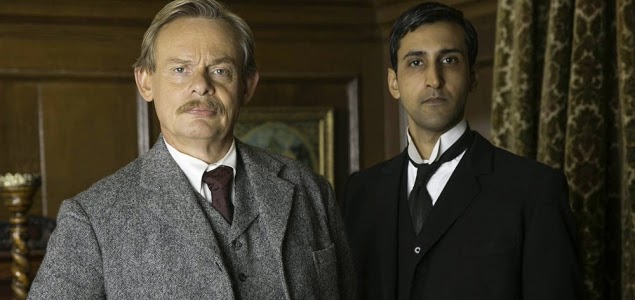
Julian Barnes's bestseller is a decade old, so fond readers may think an adaptation long overdue. This is such a fun three-parter it should have been shown at Christmas, though any case that is based on real life and involves such elements as senseless animal slaughter and racial intimidation is far from cosy. Martin Clunes does a passable Scottish accent as Sir Arthur Conan Doyle, feeling guilty and at a loose end after his long-ailing wife's death and unwilling to commit to another Sherlock Holmes adventure. Arsher Ali plays George Edalji who has served three years for killing horses under the cover of darkness, and still wants to prove his innocence.
It's a three-part ITV adaptation of a fairly hefty novel and moves quite slowly, though with some exciting Holmes-like moments. Viewers are served up pretty much what they'd expect, which in this case is a classy cast, swirling fog, comfortable middle-class Victorian homes and altogether the sort of mystery that requires only a sofa and a hot toddy to really enjoy.
Labels:
Arsher Ali,
Art Malik,
Arthur and George,
Drama,
Emma Fielding,
historical,
ITV,
Julian Barnes,
Martin Clunes,
review,
Sir Arthur Conan Doyle,
TV,
UK
Monday, 23 February 2015
Hostages
The latest in BBC4's Saturday night subtitled slot is Israeli drama 'Hostages', similarly styled and paced to things like 'Homeland' and '24' but... shorter (ten 40-minute episodes). It benefits from the lack of slack, and the baggier US version was not a hit. Yael, a top Jerusalem surgeon, is about to operate on the Israeli PM. She's confident and it's a routine procedure, but the night before the scheduled op, masked gunmen break into her nice suburban home and take her family hostage, making it clear to her that either the Premier dies under her knife, or they kill her husband and two children.
Certain things must be taken as read here: Yael is resourceful and is going to try anything to save her family and her career; her teacher husband has serious financial problems which he hasn't yet got around to telling his wife about; her teenaged daughter has just discovered she's pregnant; her son is running a cheating racket for schoolmates in exams; one of the terrorists has been, at least until now, working for the state and another is a psychopath.
So far this has been a rollercoaster of neat surprises, but our question is the usual one, namely can this sustain a further eight episodes without losing the pace on the one hand or losing credibility on the other. No doubt there are more family skeletons rattling impatiently in the closet, phantoms stalking the hostage-takers and doubtless a few shady secrets surrounding the PM, though, so we're hoping for an entertaining few weeks.
Wednesday, 18 February 2015
Indian Summers
This is Channel 4's new, lavish drama about the last years of the British Raj, in the tradition of Scott's 'Jewel in the Crown' and Forster's 'A Passage to India', but without their literary sources. It's set in 1932 Simla, where the colonial ruling class retreated from the heat each summer.
Alice (Jemima West) is taking her baby by train to join her up-and-coming brother Ralph Whelan (Henry Lloyd-Hughes), having fled an adulterous husband. Ralph meanwhile has a strange mentor in Cynthia Coffin (Julie Walters), the earthy widowed owner of the Simla Club (no dogs or Indians) who uses her servant to procure American heiress Madeleine Mathers (Olivia Grant) for him. Ralph and Alice haven't seen each other since they were separated by boarding schools as children and are uneasy in their relationship. The sense of entitlement of the British and the indolence this generates contrast sharply with the busy lives of the Dalal family, where son Aafrin (Nikesh Patel) is romancing a Hindu girl and trying to make his way in the Civil Service while his sisters are involving themselves in the growing call for home rule. Two incidents - Hindustani graffiti over a portrait of the late Queen Victoria and an injured half-caste boy lying on a railway track - intrude on the struggles for survival and one-upmanship and are the portents of change. Is Ralph a focus of discontent because of what he represents, or is it something more personal?
The trailers did this no favours, since the first, extra-long episode promises a rather more subtle drama than the likes of 'Downton'. We were given a cursory introduction to the main actors ("You never told me you were Whelan's sister - he's Private Secretary to the Viceroy!" etc.) but there was enough sex and violence to be going on with and keep up the tension: brutality and illicit affairs seem to be the tropes of any Empire saga, and as 21st Century television, this doesn't shy away from exposing the moral rot that accompanied British rule on the Indian subcontinent. Will it sustain a further 9 episodes? Just possibly, and if the experience of the Himalayan foothills and bias cut dresses to a 30s soundtrack doesn't have you fiddling with the remote, you'll probably be intrigued enough to keep following along for now.
Labels:
C4,
Drama,
historical,
Indian Summers,
Julie Walters,
TV,
UK
Monday, 16 February 2015
The Casual Vacancy
Rather too much ham?
Having not read any of the Harry Potter books, nor watched the films, we can't say we came to this with eager anticipation. Rowling seems to have set her sights firmly on the crime genre now with her second outing as Robert Galbraith on the shelves, but between magic and murder came 'The Casual Vacancy', an adult lit fic novel that garnered fairly mixed reviews.
Pagford is a fictional Gloucestershire village... and a metaphor for the seething, grasping, petty bourgeoisie of modern middle-England, according to Rowling. The first hour (of three) introduced us to the spread of characters from the rich Sweetloves ("My wife does fun runs... well she knows people who do") to young hotpants-wearing Krystal Weedon (Abigail Lawrie) whose big mouth and drug-addicted mother bring her nothing but trouble. The catalyst for the action is the death of Parish Councillor Barry Fairbrother (Rory Kinnear) who opposed the development of a town spa as "social engineering". His titular vacancy is now being fought over by the pro and anti-spa lobbies, in a way that will have the Daily Mail frothing about BBC Leftie Dramas and turning over to watch the Good Old Days of the Raj on Channel 4, or possibly the entrepreneurial (if American) spirit of Mr. Selfridge on ITV.
Did we like it? It had its moments, inevitably with this calibre of cast, but overall its tone was uneven and its characters so stark as to be almost cliche. No doubt TV producers thought the book was an obvious choice for an adaptation, but the novel is a long one, with plenty of room for nuance, and 180 minutes of television is not going to bring out the best in the material. We felt bludgeoned by the juxtaposition of soft sandstone exteriors and modern social housing, and an incessant soundtrack. Extremes exist, of-course, in real villages and towns, so it's quite a feat that this feels so unnatural. Maybe it's the - it has to be said - Harry Potteresque nature of everyone so far. The Mollisons (Michael Gambon and Julia McKenzie) are shallow, devious snobs while Fairbrother, whose online identity someone is appropriating (or are they?) to comment on the ongoing Pagford squabbles, was just trying to do the right thing for the locals, and his abused nephews. We have the comically absurd plotting of the Councillors one minute and a toddler being neglected in a drug den the next. The problem of being not-quite drama and not-quite comedy is that the social commentary comes across as rather blatant, and black and white worlds tend to make drab grey dramas.
Labels:
BBC1,
Drama,
Emilia Fox,
JK Rowling,
Julia McKenzie,
Julian Wadham,
Keeley Hawes,
Michael Gambon,
Monica Dolan,
review,
Rory Kinnear,
The Casual Vacancy,
TV,
UK
Tuesday, 3 February 2015
Fortitude
Fortitude is Sky's new big-budget drama - reportedly costing £30m for 12 episodes, broadcast here on Sky Atlantic, in the US on cable network Pivot, and pre-sold to a number of other broadcasters around the world.
We should start with the business side of the programme, because it's clearly a business-driven enterprise - an attempt to make an internationally appealing show that will generate revenue and become a 'franchise' or more accurately, a licence to print money.
The different elements are there - an international cast of well-respected actors (Brits, Nordics, Americans), internationally known stars from previous big hits (Sophie Gråbøl from 'The Killing', Christopher Eccleston from 'Doctor who', Michael Gambon from the 'Harry Potter' films, Stanley Tucci from 'The Hunger Games'), a beautiful and unusual setting - the Arctic - and a script that promises lots of twists and turns, not to mention red herrings.
Fortitude is the name of a small town in the Arctic Circle, and serves as the setting for the show. Based on Svalbard, a town with a population of 2,000 people, Fortitude itself has just 700 people, and as the Mayor, played by Sophie Gråbøl, explains, everyone who is there has a job, so there is no crime. Characters range from policemen, photographers, doctors, plus what looks like some miners or similarly industrial workers. Oh - and there's a bar full of hairy heavy metal fans with unspecified jobs, and there seem to be just two children that we've seen so far (and presumably a school teacher?).
Given that you have this community of interdependent people in a hostile environment, what it resembles a bit is a space drama. Who is killing members of the crew? Is it a monster out in the wild, or is it the enemy within?
The first episode moved along well though, and we will continue watching. Whether it justifies the big investment from a financial point of view remains to be seen; the last show Sky heralded quite as enthusiastically as this was The Tunnel, and that never made it to a second series.
Subscribe to:
Posts (Atom)